Archive for the ‘News’ Category

Now Hiring: Preservation Specialist

Körner’s Folly Foundation

Position Title: Preservation Specialist

The Körner’s Folly Foundation, a 501(c)(3) nonprofit organization, is seeking a practical, detail-driven team member to help carry out our mission to foster an appreciation for history, the arts, and enterprise through the preservation and interpretation of Körner’s Folly.

The Preservation Specialist is responsible for leading the day-to-day stewardship of Körner’s Folly’s historic buildings, collections, and preservation systems. This position leads routine monitoring, documentation, preventive care, and follow-through on facilities and collections needs; coordinates qualified contractors and specialists; and helps ensure that preservation concerns are identified early and addressed according to appropriate standards and practices.

Because preservation is inseparable from daily museum operations, the Preservation Specialist also works regular public-facing shifts in the historic house and/or Visitors Center. This position helps open and close the site, supports visitors and coworkers, and observes how the buildings and collections perform under real operating conditions. This role reports to the Executive Director and works closely with the Operations Coordinator, Community Engagement Manager, Visitor Services staff, volunteers, contractors, and professional preservation consultants.

Primary Responsibilities

  • Historic Preservation & Facilities Stewardship: Serve as the staff point person for routine preservation and facilities needs across the campus infrastructure; conduct and document regular building and grounds inspections; maintain prioritized maintenance, repair, and preservation logs and follow issues through resolution; coordinate approved contractors, service providers, and other vendors including scheduling, site access, documentation, and follow up; carry out or coordinate appropriate routine preventative maintenance and minor repairs within the position’s training and authority; monitor and help maintain security, fire/life-safety, HVAC, plumbing, electrical, lighting, pest-management, and environmental control systems as they affect the site and collections; help develop and implement emergency preparedness, disaster response, housekeeping, and collections care; support preservation and capital projects through condition documentation, research, progress tracking, and organized retention of plans, warranties, reports, and service records; ensure that work affecting the historic fabric follows approved plans, institutional policies, and recognized preservation practices.
  • Collections & Archival Stewardship: Process, inventory, catalog, and maintain physical and digital collection and archival materials; monitor storage and display conditions and implement preventive collections care; identify collections risks and conservation needs and assist the Executive Director and outside specialists with care planning and treatment coordination; create archival housings and exhibit supports using appropriate materials; assist with object movement, exhibit preparation, installation, and de-installation; support the development and consistent application of collections-management policies and procedures, including access, loans, acquisitions, deaccessioning, and emergency response; train and supervise assigned volunteers, interns, or staff in safe object handling and approved collections-care tasks.
  • Visitor Services & Museum Operation: Work regular Visitor Services shifts and act as the responsible on-site staff member when assigned, including opening and closing the Visitors Center and historic house museum; welcome visitors and introduce the history of Körner’s Folly, the Körner family, Kernersville, and the American Victorian period in an accurate and engaging manner; follow procedures for admissions, online, and in-person ticketing, gift shop sales, cash handling, daily reconciliation, and site security; assist with educational programs, tours, facility rentals, and special events; conduct historical and collections research and contribute to interpretive materials, exhibits, tours, and programs as assigned in collaboration with the Community Engagement Manager.

Desired Qualifications

  • Bachelor’s degree or equivalent education and experience in historic preservation, museum studies, public history, history, collections management, archives, conservation, facilities stewardship, or a related field.
  • Working knowledge of preventive conservation, collections care, historic-building maintenance, or preservation practice; direct experience in a museum or historic site setting strongly preferred.
  • Ability to recognize building and collections risks, document conditions clearly, establish priorities, and carry projects through to completion.
  • Experience coordinating vendors, contractors, volunteers, or multi-step projects while maintaining accurate records and deadlines.
  • Strong organizational, research, problem-solving, written communication, and interpersonal skills, with excellent attention to detail.
  • Comfort with Microsoft office and digital file management; familiarity with collections databases, metadata standards, environmental monitoring, or digitization workflows is a plus.
  • Sound judgment and discretion when working around historic materials, sensitive records, visitors, staff, and active project sites.
  • Commitment to collaborative work, public service, and the mission of the Körner’s Folly Foundation.
  • Formal education and experience may vary but should be sufficient to provide the knowledge, judgment, technical aptitude, and organizational skills required for the scope of work.


Work Conditions & Requirements

  • Work is performed in offices, collections, and storage areas, a modern Visitors Center, outdoors, and throughout a multilevel historic house with narrow passages, uneven surfaces, and numerous stairs and steps.
  • The position requires frequent standing, walking, bending, reaching, and stair climbing; careful handling of objects and equipment, and the ability to lift and carry up to 30 pounds with or without a reasonable accommodation.
  • Some work may occur in dusty, warm, cold, or confined areas and near active maintenance or preservation projects. Appropriate safety procedures and personal protective equipment must be used.
  • Regular weekend work and occasional evening work are required based on the museum, program, and project calendar.
  • Reliable transportation, a satisfactory criminal background check, and valid, up-to-date government identification are required.

This is a part-time position that reports to the Executive Director and works closely with the Community Engagement Manager, Operations Coordinator, and Visitor Services Associates. The Körner’s Folly Foundation is an equal opportunity employer.


Compensation:

Part-Time position: 25-30 hours per week
$18.00 per hour

How to Apply:

Interested candidates should submit their resume, cover letter, and at least two professional references via email to Suzanna Ritz Malliett, Körner’s Folly Foundation Executive Director, at director@kornersfolly.org by October 9, 2026. 

Pergola Progress: Preparing the Pathway

Pergola Progress: Preparing the Historic Pathway

Visitors to Körner’s Folly will notice a visible change in the landscape surrounding the historic pergola: the concrete walkway that once extended from the historic privy past the pergola has now been removed.

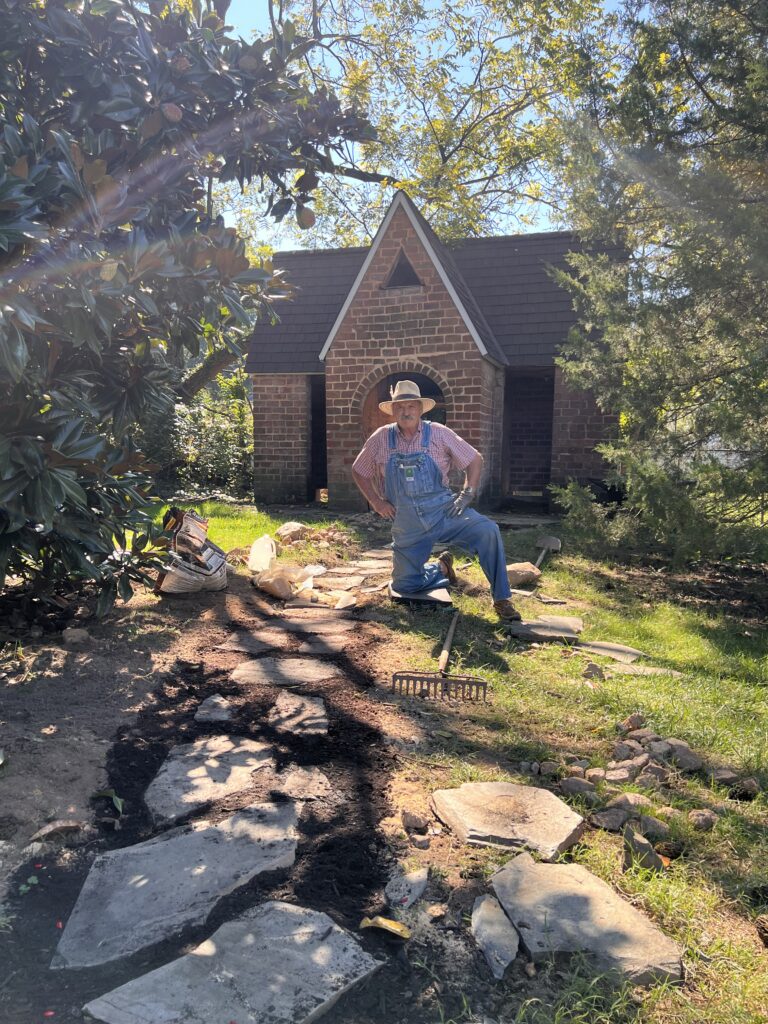
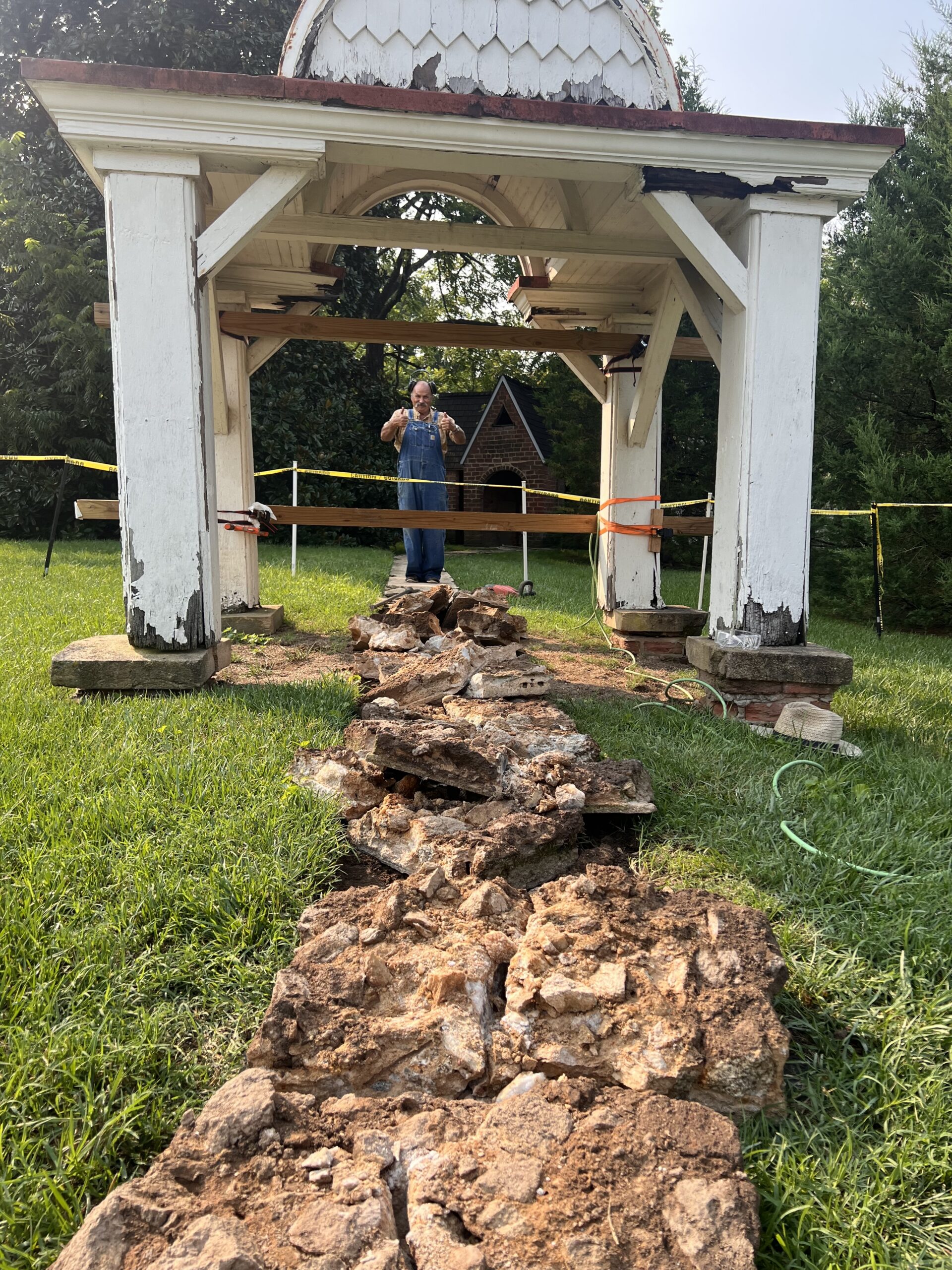
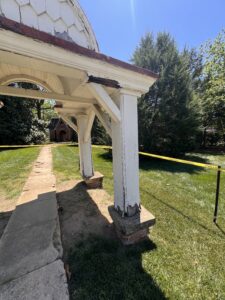
Preservationist and contractor Dan Ledbetter recently completed the demolition and removal of approximately 70 feet of concrete walkway. The concrete was carefully broken into smaller sections by hand, removed from the property, and delivered to a nearby recycling center. The newly exposed pathway was then raked and prepared for the installation of slate stepping stones.

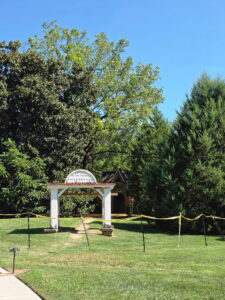
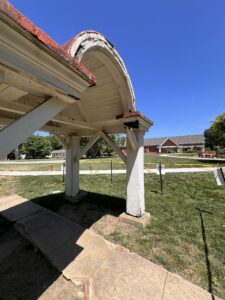
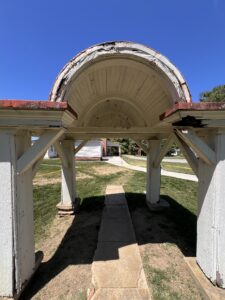
The latest photographs show the cleared route extending through the pergola toward the historic privy. Removing the concrete has made the physical relationship among these features of Jule Körner’s landscape more visible while preparing the site for a pathway that is better integrated with the project’s preservation plan.

This work represents an important transition between investigation and restoration. Project leader David Gall is developing specifications for the slate stepping stones within the approved plan, and Dan will begin staging materials for the next phase. Temporary supports remain in place around the pergola while preparations continue for repairs to the historic structure itself.

As with the stabilization work already performed, the pathway is being approached incrementally. Each step, including removing later materials, recycling debris, preparing the ground, selecting appropriate replacement materials, and coordinating the pathway with the pergola’s structural needs, contributes to the long-term care of the site.


Preservation progress is sometimes most visible in what has been carefully removed. The open path seen today is not the finished result, but the evidence that the site has been cleared, studied, and prepared for the next layer of work.

We are grateful to Dan, David, and the entire project team for the care they continue to bring to this distinctive part of the Körner’s Folly landscape. We are also deeply grateful to every campaign supporter who leapt into action and made this urgent preservation work possible.

We look forward to sharing the installation of the slate pathway and the beginning of structural repairs as the project moves forward!

September Collections Spotlight and From the Archives

Collections Spotlight:
European Wooden Shoes

In honor of Körner’s Folly’s upcoming 16th Annual Oktoberfest, we highlight a Körner family collection item newly on loan from the Wolfe family. This month we showcase a pair of wooden shoes, most likely of German origin, crafted in the 1800s. At first glance, this pair of simple, wooden shoes may seem like an ordinary object to find among the vast collection of elegant furnishings and decorative objects within Körner’s Folly. Yet these humble shoes may offer a fascinating glimpse into the German heritage of the Körner family and the traditions they carried with them across the Atlantic.

Carved from a solid block of wood, most likely beech or poplar, and shaped to enclose the entire foot, wooden shoes such as these were once common throughout northern and central Europe. In German-speaking regions, wooden footwear was known by a variety of names, including Holzschuhe and Holschen. Practical, durable, and inexpensive, wooden shoes were particularly useful for agricultural and outdoor work, protecting the feet from mud, moisture, and rough terrain. Regional styles varied considerably, and the long, pointed toes of this pair are found in many German speaking regions.

The exact origin of the Körner family’s shoes, whether inherited or purchased, is still being determined, but is consistent with European wooden footwear of the 18th and 19th centuries. By the beginning of the twentieth century, wooden shoes were becoming less common as everyday footwear since inexpensive manufactured leather shoes became increasingly available. Whether the Körner family shoes were once used practically, or were purchased as a token of the family heritage, they showcase a strong cultural connection to the family’s lineage.

Perhaps most intriguing is that the shoes appear in an early photograph of Körner’s Folly dating to approximately 1907. In the photograph, the pair of elongated wooden shoes can be seen resting on the floor of the Reception Room, among the room’s elaborate furniture, rugs, artwork, and decorative objects, just under the ornate “Japanese Cabinet” purchased from the Chicago’s World’s Fair. Their placement in this formal space suggests that they may have held significance beyond their practical use and were an interesting focal point in a room with so much character.


Today, these shoes provide more than an example of historic footwear. They showcase a physical connection between Körner’s Folly and the European heritage of the family who built it. Perhaps these shoes were worn by a Körner ancestor, carried across the Atlantic, or simply a treasured reminder of Germany. We may never know their entire journey. But their appearance in the house more than a century ago tells us one thing for certain, the wooden shoes were important enough to keep and display among all of Jule Körner’s important possessions!

From the Archives:
Gilmer and Doré Trace their Lineage, Post-World War I

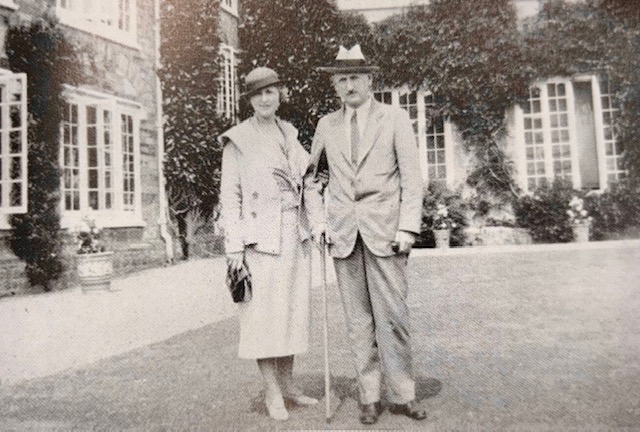
At left: Gilmer Körner and Doré Körner Donnell in 1935. Together, they visited several countries in Europe in search of their family history. In this photo, Gilmer and Doré are in Devonshire, tracing their mother’s lineage.

In 1912, Doré Körner embarked on a Grand Tour across Europe, the Middle East, and Northern Africa, combining a passion for travel with a deeply personal search for her family’s ancestral roots. Among her most important destinations was Germany, where she sought to reconnect with relatives of the Kerner and Körner family lines.

In the Black Forest region, Doré traced her maternal ancestry to the Wintermantel family and established a meaningful connection with her German relatives. What began as an ancestral search quickly developed into a lasting family relationship. Even after Doré returned to North Carolina, the Körner family continued to correspond with their German relatives, exchanging letters and expressing hopes of one day visiting one another again.

The outbreak of World War I, however, made communication increasingly difficult. Despite the conflict separating them, the letters exchanged between the families reveal that the war did not diminish Doré’s affection for their German relatives. One cousin wrote to Doré during the early years of the war, stating:

“We hope this terrible war will soon be ended and that we can correspond again without difficulty. I am very busy, as all others are, for the Red Cross. In eight days, 100 pairs of socks must be finished and sent to the soldiers. Oh, it is all so horrible. I wish you all a very happy Christmas and a joyful New Year, hoping that my next letter may be written in peace. I hope to receive an answer by the New Year. Address me at my cousin’s in Switzerland.”

Though their countries were divided by a devastating international conflict, the family’s personal bond remained. Their correspondence was interrupted by war, but their connection endured. After the war, Doré and her brother, Gilmer, returned to Europe on several occasions to visit their relatives in Germany and continue tracing their family history. Their journeys demonstrate that the war had not turned them away from their German heritage or the family they had discovered there. Instead, they continued to embrace those connections as an important part of their shared ancestry.

After World War I, Gilmer stated he traveled each year to Germany, up until the beginnings of World War II. Today, the German connection remains strong in Kernersville, partially due to the continued connection of the Körner family to their ancestral homeplace and kin.

Pergola Progress: Preservation Begins with Paying Attention

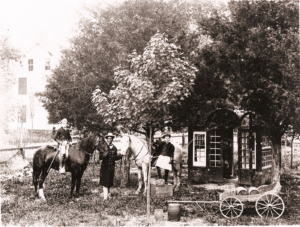
Visitors arriving at Körner’s Folly may have noticed that work is underway around the historic pergola that once served as a children’s playhouse as well as stable entrance. Although the pergola has long been one of the property’s quieter architectural features, it remains an important part of the landscape Jule Körner created, and preserving it requires the same careful attention we give to the house itself.

The project is being led by preservationist David Gall, with additional expertise provided by an architect, structural engineer, and archaeologist. Together, the team is studying the pergola not as an isolated structure, but as part of a larger historic landscape shaped by its materials, construction, foundations, surrounding soil, and patterns of use.

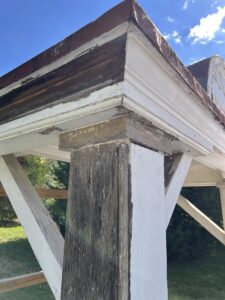
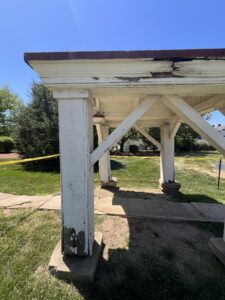
The first phase of work has focused on structural stabilization. Like many historic outdoor structures, the pergola has endured decades of exposure to rain, sun, shifting soil, and changing vegetation. Before its decorative details can be addressed, the structure must first be made stable and secure. Preservationist and contractor Dan Ledbetter has been working carefully with the project team to support the pergola while evaluating how its surviving historic materials can be retained. His approach involves using temporary and reversible bracing to add more support for the vertical columns while plans for restoration take shape.

Work has also begun on the surrounding site and pathway. Removing portions of the path has made it possible to better understand conditions at the base of the structure and address the factors contributing to its movement over time. The involvement of an archaeologist helps ensure that ground disturbance is approached carefully and that any evidence uncovered during the work is properly observed and documented.

This type of progress is not always dramatic or immediately visible, but it is essential. Successful preservation often begins below the surface, with drainage, soil, foundations, and the relationship between a structure and the landscape around it.

One of the central goals of the project is to preserve as much of the pergola’s historic fabric as possible. Rather than replacing the materials outright, we are approaching the work incrementally: stabilizing what remains, documenting existing conditions, consulting across disciplines, and making thoughtful decisions about each repair. The weathering, patina, and irregularities of the original materials are part of the pergola’s story. Preservation does not mean making an old structure appear brand new; it means allowing it to continue while retaining the evidence of its age, craftsmanship, and use.

There is still more work ahead, including repairs to the pergola’s architectural and decorative elements. We will continue sharing photographs and updates as the project progresses. For now, we are pleased to see this distinctive part of the Körner’s Folly landscape standing more securely, and grateful for the expertise, patience, and close attention that meaningful preservation requires.

At Körner’s Folly, preservation is rarely a single dramatic transformation. More often, it is a series of careful choices: supporting a leaning post, uncovering the ground beneath a path, studying an old joint, or pausing before deciding what should be replaced. Each small decision helps ensure that the house and its surrounding landscape remain available for future generations to encounter, study, and enjoy.

July Collection Spotlight and From the Archives

Victorian-era bud vase circa 1890s. This piece is etched with beautiful leave and floral designs and would have complimented mantels or tables with a single bud.

In honor of our upcoming Fourth Annual Folly Flower Show, this July we highlight a beautiful etched glass bud vase, once owned by the Körner family. This delicate vase reflects the quiet elegance and sentimentality of everyday decorative objects in the late 19th and early 20th centuries.

Made popular from the Victorian obsession with “Floriography,” or the study of flowers, bud vases were a common decorative object for middle-class homes during the late 1800s. Typically made from opaline, satin, or clear etched glass, the small delicate vases optimized Victorian sentimentality as well as the rising consumer culture after the Industrial Revolution. Glass bud vases were often placed on mantels, bedside tables, or dining settings, where they added a subtle but intentional touch of beauty to the surroundings. Their small size made it perfect for conversations, without having to lean around large arrangements. Bud vases were both decorative and accessible, but not overly extravagant, and were a popular gift given during the late-Victorian period.

Slight in form with a gently flared rim and stable circular base in a trumpet style, the Körner family glass bud vase was designed to hold a single bloom or a few small stems, showcasing even the simplest flower as something worthy of prominence in a room. The vase’s surface is adorned with a graceful floral motif, likely achieved through acid etching or fine engraving. The soft, matte quality of the design contrasts with the smooth clarity of the glass, allowing the stylized flower and flowing leaves to stand out without overwhelming the form. This naturalistic decoration aligns with popular aesthetic trends of the Victorian and early Edwardian periods, commonly referred to as the Arts and Crafts Movement, when botanical imagery and delicate ornamentation were widely favored.

As an object once owned by the Körner family, this bud vase offers insight into the layered approach to interior design practiced within the home. Most likely received as a gift for a special occasion, this piece would have been beautiful in any room of Körner’s Folly. Jule Körner, known for his artistic vision and attention to detail, understood the importance of even the smallest decorative elements in creating a cohesive and inviting space. Objects like this vase contributed to the overall atmosphere of the house, demonstrating how beauty was woven into daily life. Though modest in scale, it stands as a meaningful example of how personal taste and design sensibility were expressed through everyday items.

From the Archives – 1974 Folly Flower Show and the Original Circle of 26

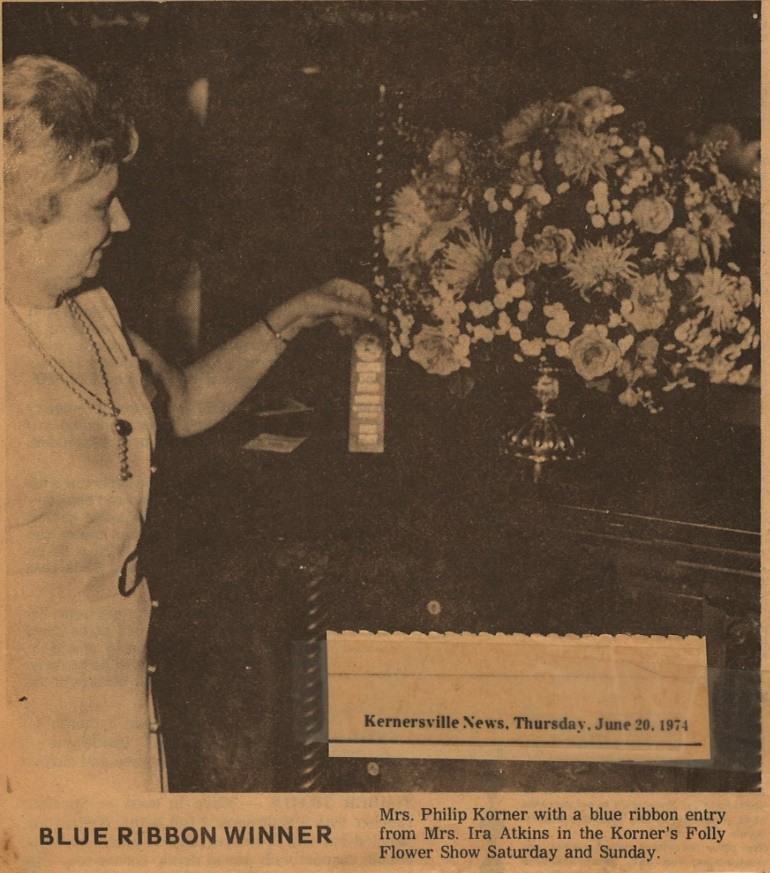
In the image above,  a newspaper clipping from “The Kernersville News” shows Mrs. Phillip Körner standing with a floral display during the 1974 Folly Flower Show. This arrangement, created by Mrs. Ira Atkins, was displayed in the Dining Room and received the blue ribbon prize. Körner’s Folly Inc. held special events, such as flower shows and other fundraising balls and parties to raise funds for and awareness of historic Körner’s Folly.

Körner’s Folly, Inc. set in motion the restoration efforts of “The Folly” in order to share its wonders with Kernersville, the Piedmont Triad, and beyond. The group helped raise funds for general upkeep and restoration, and even performed maintenance and repairs on the structure themselves, including replacing and painting shutters, mold remediation, and carpentry. The Körner’s Folly Foundation has this group to thank for the beginnings of the preservation and restoration of Jule Körner’s incredible building.

Those members of Körner’s Folly Inc. are as follows: Vernon & Nita Atkins; Mabel, Scott, and Judy Beeson; Solly & Becky Coltrane; Ed & Martha Crawford; Jim & Jo Fitzpatrick; Kenneth Greenfield & Amanda Ritchie; Sallie Greenfield; Chall & Vera Hayes; Ted & Betty Lou Kerner; Philip & Mary Ruth Körner; John Lain; Clarence & Imogene Lambe; Neil & Betsy Oerter; Wes & Darlyne Phillips; Billy Pope; Lawrence & Etta Pope; Hafford, Mary, Joyce, & Bill Porter; Tom & Helen Prince; Elizabeth & Mary Stuart Sparks; Ron Styers; Jim & Mary Turner; W.T. & Clem Walker; Richard & Mary Whitaker; Jack & Betty White; Margaret Wilson, and John, Bobbie, Jack & Polly Wolfe.

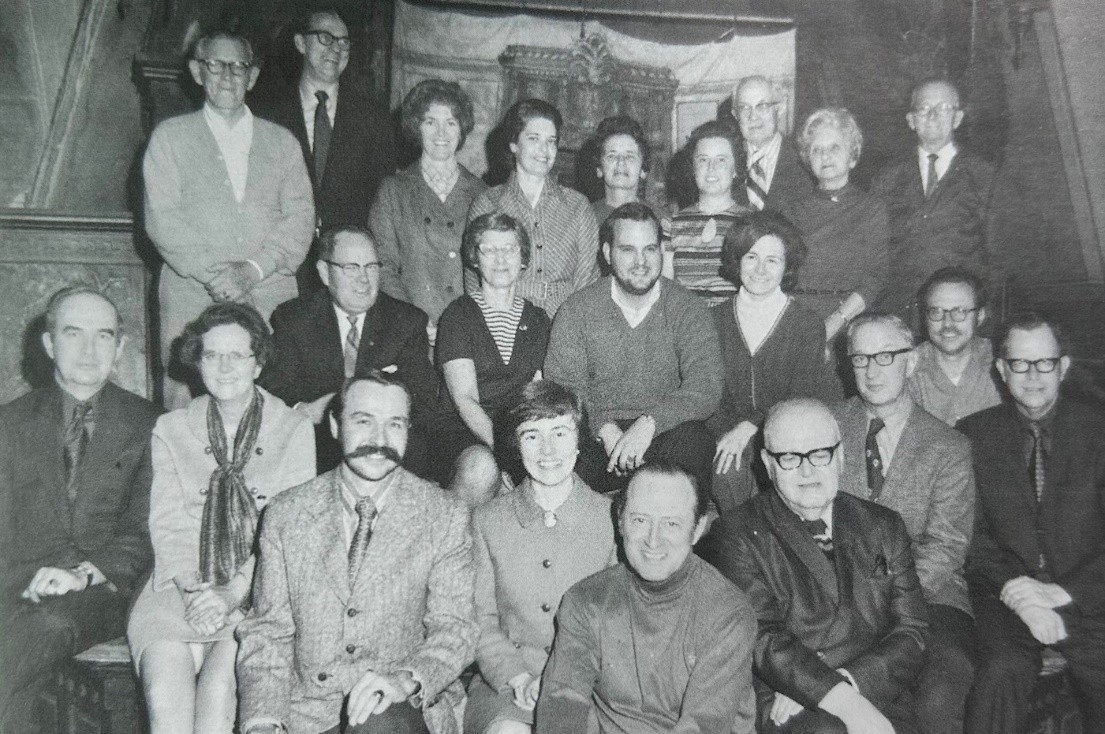
The image above was taken inside Cupid’s Park Theatre at Körner’s Folly during the 1970s. Members of the original 26 families sit or stand across the historic stage.

June Collections Spotlight and From the Archives

For our June Collection Spotlight, we invite you to explore the remarkable free-hand fresco paintings that grace the interior of Körner’s Folly, each one lovingly created by German artist Caesar Milch. Milch came to work with Jule Körner sometime after Körner’s marriage to Polly Alice Masten in 1886, and he remained a trusted collaborator for the rest of his life. A graduate of the Royal School of the Arts in Berlin in 1894 and an accomplished decorative painter specializing in figures and floral forms, Milch played a vital role in shaping the Folly’s richly ornamented interiors. Under Körner’s visionary direction, Milch helped transform Körner’s Folly into a vivid expression of Gilded Age design at its height, where painting and architecture came together to form a unique immersive artistic environment.
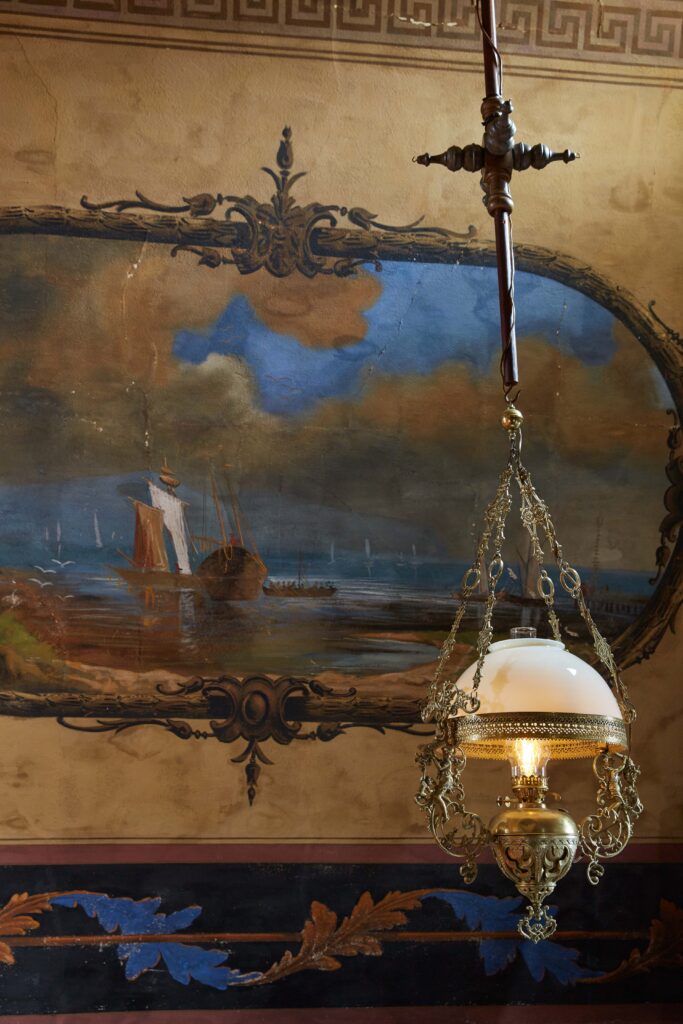
This hand-painted fresco by German artist Caesar Milch reflects the late 1880s fascination with immersive interior design, where walls became storytelling surfaces rather than mere walls. Drawing on European traditions of decorative painting, artists used techniques such as trompe-l’œil and layered washes to create depth, atmosphere, framing, and illusion within their designs, transforming domestic spaces into imagined landscapes. Originally created from a maritime scene of Holland Jule Körner sketched during one of his travels, scenographic displays offered both escapism and sophistication, aligning the home with ideals of travel, culture, and refinement. In spaces like Körner’s Folly, frescos such as these elevate the interior into a total work of art, where architecture, decoration, and narrative seamlessly intertwine.

During the late 1800s, American design embraced what is often called the “cult of ornament.” Pattern, color, and craftsmanship were highly valued, and interiors became increasingly elaborate. Freehand wall and ceiling painting fit perfectly into this aesthetic. Popular imagery included floral and botanical motifs, trompe-l’œil and architectural details, classical scenes and allegorical imagery, and intricate borders and ceiling medallions. These designs were especially popular in theaters, music rooms, and grand homes, especially in spaces meant to impress and entertain.

Specifically, freehand fresco-style decoration became fashionable in American interiors during the late 19th century as part of a broader shift toward highly personalized, artistic living spaces. As a reaction to mass production and the Industrial Revolution, affluent homeowners and designers began embracing hand-painted walls and ceilings that reflected European traditions, individual taste, and a growing appreciation for fine art within the home.

The roots of this trend lie in European fresco traditions, particularly those of the Italian Renaissance and later decorative arts movements in France and Germany in particular. As artists trained abroad, such as Caesar Milch’s time at the Royal School of the Arts in Berlin, ideas were brought from Europe, carrying these techniques with them. Fresco and fresco-secco allowed for richly detailed, custom designs that elevated interiors beyond simple decoration into immersive artistic environments.
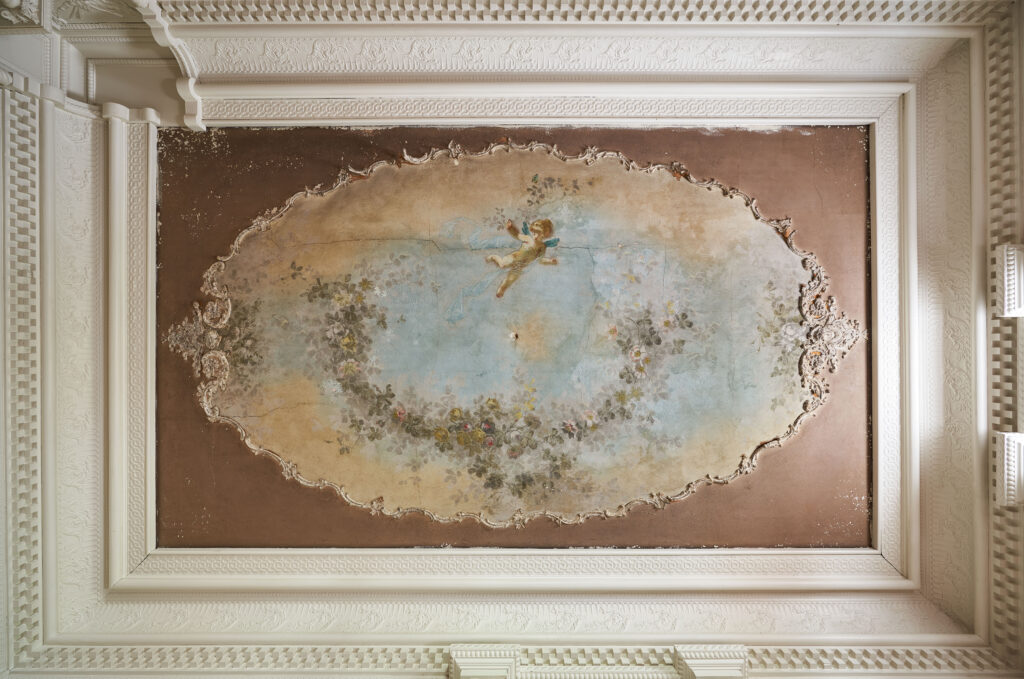
Framed by an ornate plaster cartouche, the composition centers on a delicately rendered putto drifting through an illusionary sky, encircled by a garland of florals. Another example of a fresco by German artist Caesar Milch, he employs techniques associated with fresco-secco painting, painting on dry plaster, utilizing subtle tonal gradation, diffused edges, and a muted pastel palette. This design style was to evoke an illusionistic depth that dissolves the architectural boundary of the ceiling, a popular trend in highly ornate homes from the 1800s. Such compositions draw from Rococo and Neoclassical precedents popularized in 18th century France and Italy, and later revived in Germany during the 19th century. Imagery such as this putto were utilized as symbols of refinement and cultural sophistication in domestic spaces. In Victorian America, particularly in homes like Körner’s Folly, these hand-painted ceilings demonstrated both the skill of the artist and taste of the designer while transporting the viewer into a scenic view of the illusionary heavens.

Milch drew upon the popularity of ornamental painting during his work at Körner’s Folly, as well as in other projects completed through the Reuben Rink Company. His training took place at a time when decorative fresco and interior embellishment were at the height of fashion, shaping both his technique and artistic direction. Milch studied fresco painting and design under the guidance of Phillip Franck, a noted instructor of plaster drawing and ornamentation who began teaching in 1892 and later served as acting Director of the art school from 1912 to 1929. An accomplished author and influential figure in the reform of drawing and art education in Germany and Prussia, Franck left a lasting international impression on the study of ornamentation and design.

Milch’s work with the Reuben Rink Company reflects his academic foundation, with clear ties to those principles with his stylistic approach in creating highly ornamental designs. By the early 20th century, tastes began to shift in interior design due to changing philosophies with interior spaces, leading to a decline in elaborate painted decoration. However, surviving examples, like those of Körner’s Folly, offer valuable insight into a moment when interiors were conceived as immersive, handcrafted environments. These works remain important not only as decoration, but as expressions of artistic collaboration, cultural exchange across oceans, and the aspirations of America’s Gilded Age.

From the Archives: 
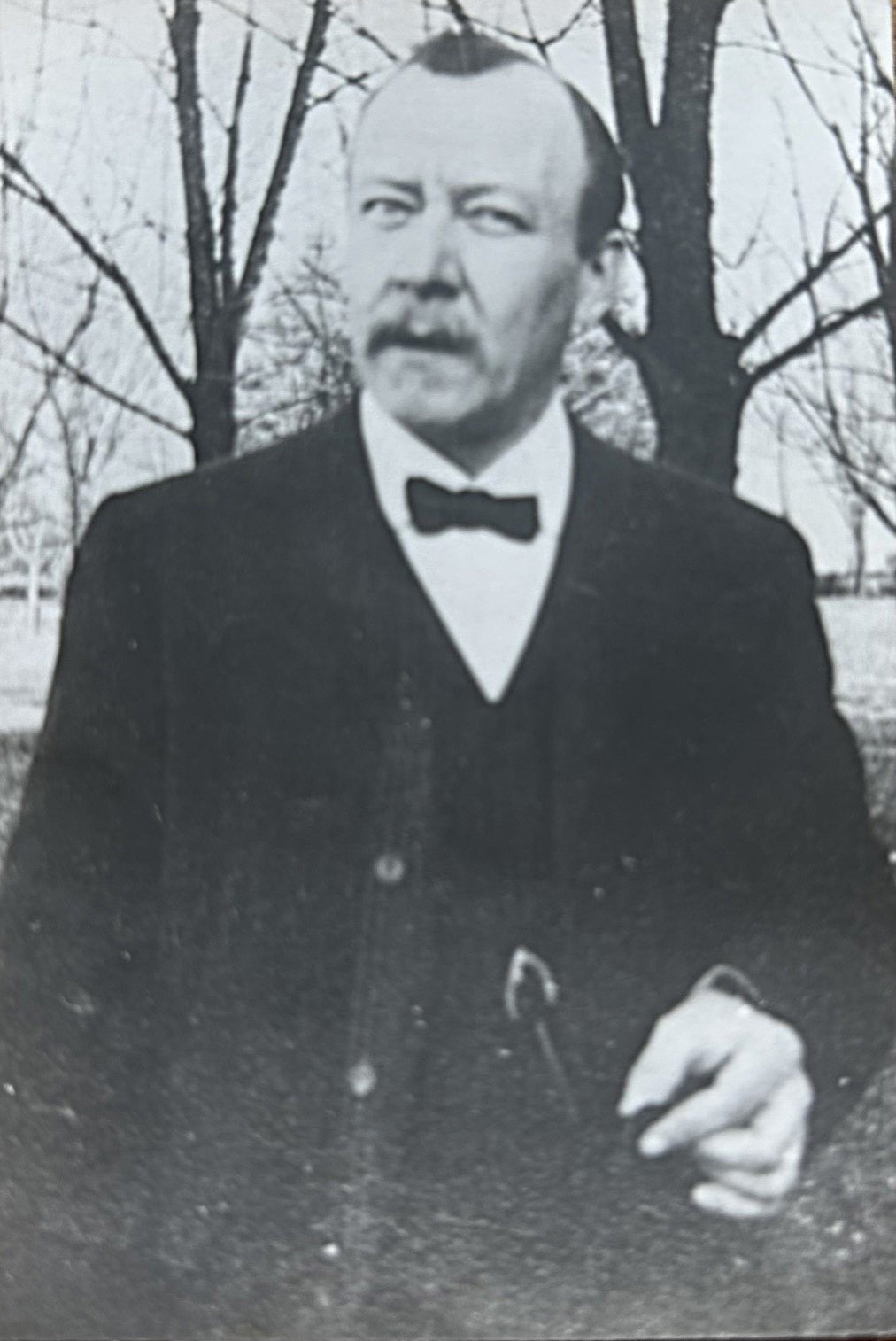
This photograph depicts Herr Caesar Milch in the late 1910s, a close personal friend of Jule Gilmer Körner and the freehand fresco artist for the Reuben Rink Decorating and House Furnishing Company. Milch collaborated alongside Körner for more than 30 years, remaining in his employ until his death in 1922. With the exception of the wall mural in the North Stairway, painted by Körner shortly after 1880, the surviving murals throughout Körner’s Folly are attributed to Milch’s skilled hand.

Milch joined Körner not long after Jule’s 1886 marriage to Polly Alice Masten of Winston-Salem. In her memoir I Remember, Polly Alice recalls, “Later, I cannot recall how soon after we were married but not long thereafter, Jule went to New York and brought back a young German artist (Caesar Milch) from Berlin, who set to work to decorate all the walls and ceilings up there (Cupid’s Park Theatre). He was at that job for many months and that was the beginning of a lifelong employment of Herr Milch, who was never out of Jule’s employment as long as they both lived.”

Though dedicated to his work in Kernersville, Milch periodically returned to New York and Germany to refine his craft. In 1893, he traveled to Berlin to visit family and further his artistic training at the Royal School of the Arts, a state institution established in 1869. By the turn of the 20th century, the Reuben Rink Company proudly promoted Milch as a graduate of this prestigious school, declaring he “has no peer in this country in the artistic field.”
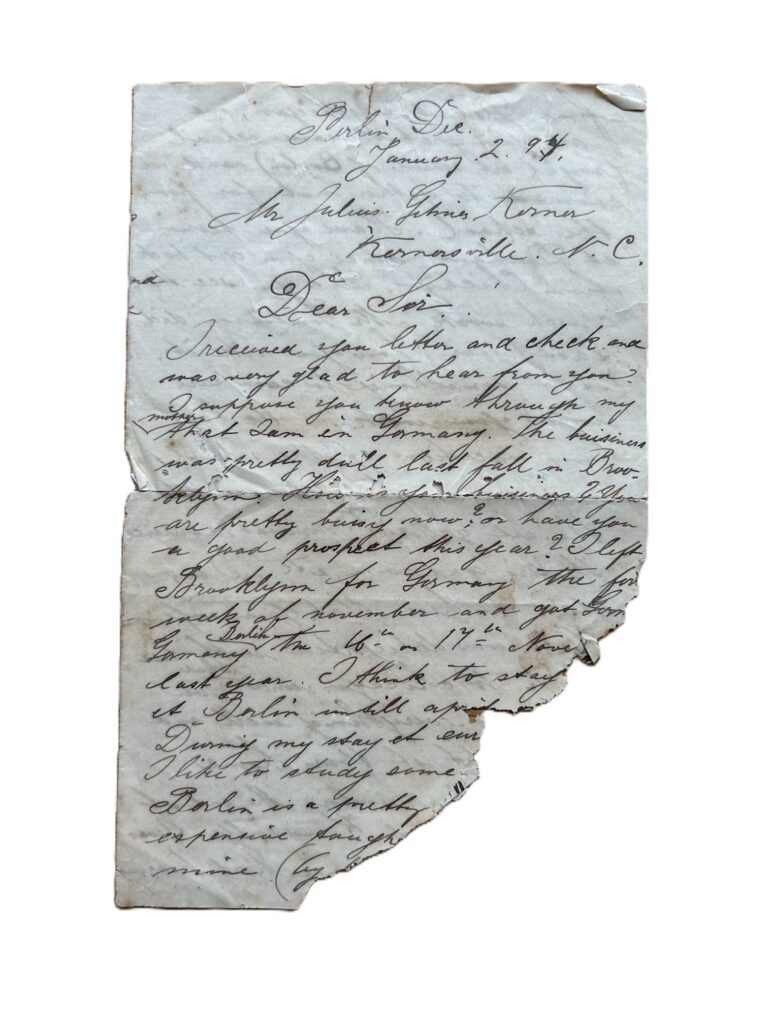
The letter displayed here, written by Milch to Jule Körner during his time in Berlin in 1894, offers a personal glimpse into his artistic pursuits abroad and reflects his enduring connection to the Körner family and the Kernersville community. Unfortunately, some of the letter is missing, but most of it is preserved. Caesar wrote:

“Berlin, Germany
January 2, 1894
Mr. Jule Gilmer Kerner
Kernersville, N.C.

Dear Sir,

I received your letter and check and was very glad to hear from you. I suppose you know through my mother that I am in Germany. The business was pretty dull last fall in Brooklyn. How is your business? You are pretty busy now? Or have you good prospects this year? I left Brooklyn for Germany the first week of November and got home to Berlin Germany the 16th or 17th November last year. I think to stay here in Berlin until April or May. During my stay at Europe___.I like to study some ____. Berlin is a pretty ____ expensive [though].

From Dihart [sic], Michigan, we are going to the same school [Royal Art School of Berlin] and we room together not far from the school. Have you been at Durham since you got back from Chicago? Did you see the church work Mr. Tomlinson did last year? How you like it? Is it something to compare with your work? We have no vacation at the school and are on foot to see all the fine art gallerys [sic], private residence, theaters, and so on, etc. I was glad to hear that your wife ___ was delighted with her trip to Chicago and that you ____ everything well….

Hard hearing, at home [Brooklyn] and this place also, and now it has been restored, because I went to the dispensary of this place, my hearing seems to be now as well as it has been. I like to make me some inquiries about yours and your wife health? How are your brothers and their wifes [sic]? My grandfather died last year December 22, ‘93 and the funeral was a very fine one. We have it very cold now and plenty of snow. How is the weather at your home?

Please tell your brother Henry and his wife my best regards and I send to all I know at Kernersville my best wishes to New Year. I like to hear a few lines too. I am____

Please let me hear from you again. Please send me a Kernersville News to my address. I like to hear from the old home stead. Kindly regards to you and your beautiful and lovely wife Alice.

I remain,

Respectfully, Yours truly,
Caesar Milch
Care of Royal Art School
Kloster Ln. 57
Berlin
Germany

P.S. Please send your letters and newspaper to my mother’s address and in turn she will forward them.”


Körner’s Folly Launches Pergola Restoration Campaign with June Garden Party Fundraiser

Körner’s Folly Launches Pergola Restoration Campaign with June Garden Party Fundraiser

KERNERSVILLE, NC — Körner’s Folly Foundation has officially launched restoration efforts for the historic Pergola located on the north-rear side of the property, accompanied by a new public fundraising campaign and a celebratory summer event, Party for the Pergola, taking place Thursday, June 4, from 5–8 pm.

Originally constructed as part of the Körner family’s children’s playhouse before later serving as an entrance feature to the estate’s stable complex, the pergola remains one of the most distinctive surviving landscape structures on the property. Though modest in scale, the structure reflects Jule Gilmer Körner’s characteristic improvisational design sensibility — adapting, reusing, and reshaping architectural forms over time.

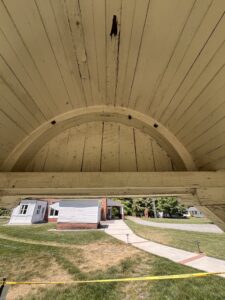
The project will address long-term stabilization and preservation concerns while retaining the pergola’s historic character and relationship to the surrounding grounds. Architectural features include a barrel-vaulted form, decorative fish-scale shingles, projecting knee braces, and a deeply picturesque silhouette.

“Körner’s Folly has always been a place where architecture, landscape, and imagination overlap,” said Suzanna Ritz Malliett, Executive Director of Körner’s Folly Foundation. “This structure tells a layered story about adaptation, resourcefulness, and everyday life on the property. Restoring the pergola allows us to preserve not only a historic feature, but the atmosphere and continuity of the landscape itself.”

The public fundraising goal for the project is $20,000. Early support has already been provided by the Kernersville Historic Preservation Society through a $1,000 leadership gift and an additional $2,000 matching challenge.

To celebrate the launch of the campaign, Körner’s Folly Foundation will host Party for the Pergola, an evening garden fundraiser featuring live music, botanical cocktails and non-alcoholic refreshments, a tea-party-inspired menu by Short Street Bakehouse & Café, creative hats and garden attire, and a silent auction featuring items for gardeners, artists, and curious collectors.

The event will take place on the lawn surrounding the pergola itself, allowing guests to gather directly alongside the structure they are helping preserve.

Early Entry tickets are $100 and include advance access to the grounds beginning at 5 pm. General Admission tickets are $65 with entry beginning at 6 pm. Due to ABC permitting requirements, the event is limited to guests ages 21 and older.

Tickets and donations may be made online at the link below:

Restore the Pergola

The pergola restoration campaign is part of Körner’s Folly Foundation’s ongoing preservation work stewarding the 146-year-old house museum and its surrounding historic landscape.


About Körner’s Folly

Built in 1880 by artist and designer Jule Gilmer Körner, Körner’s Folly is a 22-room Victorian house museum located in Kernersville, North Carolina. Known for its theatrical architecture, hand-painted interiors, and richly layered design, the site welcomes visitors from across the country for tours, exhibitions, concerts, educational programs, and community events.

For more information, visit:

https://www.kornersfolly.org

Media Contact

Suzanna Ritz Malliett
Executive Director, Körner’s Folly Foundation
suzanna@kornersfolly.org
(336) 996-7922

Piedmont Wind Symphony Residency at Körner’s Folly

PIEDMONT WIND SYMPHONY RESIDENCY AT HISTORIC KÖRNER’S FOLLY
Year-long chamber series brings music back to America’s first private little theatre

WINSTON-SALEM, NC – Music and history will meet in a unique new partnership this year as Piedmont Wind Symphony begins a special residency at Körner’s Folly, presenting a series of chamber concerts inside the historic Cupid’s Park Theatre. The residency will feature four immersive performances throughout 2026, returning the space to its original purpose as a gathering place for artistic expression, storytelling, and community connection.

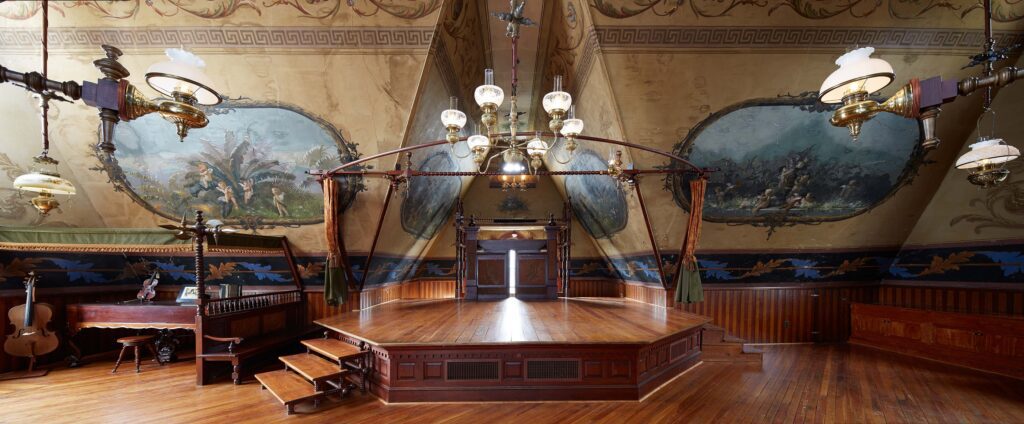
Built in 1880 by designer and artist Jule Gilmer Körner, Körner’s Folly was envisioned as a place where architecture, art, and performance could intersect. Nestled within the home is Cupid’s Park Theatre, widely believed to be America’s first private little theatre. With its natural acoustics and intimate setting, the historic theatre provides a remarkable backdrop for chamber music rooted in the musical traditions of the late nineteenth and early twentieth centuries.

Through this residency, Piedmont Wind Symphony will activate the theatre with historically inspired programming curated by Artistic Director and Conductor Mark A. Norman. Each concert in the series explores musical traditions that reflect the era in which the home was created, inviting audiences to experience music much as it might have been heard more than a century ago.

“This partnership allows us to connect music, history, and place in a truly special way,” said Brianna Cantwell, Executive Director of the Piedmont Wind Symphony. “Presenting chamber music in Cupid’s Park Theatre creates an intimate and immersive experience for audiences while honoring the musical traditions that shaped our region.”

The residency opens March 31 with Ragtime: America’s Own Sound, a lively program celebrating the syncopated rhythms that defined American popular culture at the turn of the twentieth century. The performance will also introduce Piedmont Wind Symphony’s newest chamber ensemble, the American Music Ensemble, a group dedicated to exploring the rich and diverse traditions of American chamber wind music. Once heard in parlors, theatres, and public gathering spaces across the country, ragtime captured the optimism and cultural dynamism of a rapidly modernizing America. Within the historic walls of Cupid’s Park Theatre, the music will take on new resonance, connecting listeners with the era when Körner’s Folly was still an active family home and cultural gathering space.

Additional programs throughout the year will highlight a range of musical traditions connected to the period. On May 19, Salon Solos will explore the expressive and virtuosic solo wind repertoire that flourished in intimate domestic settings during the late nineteenth century. On August 18, Bierhallen to the Bandstand will celebrate the rich tradition of German wind music, tracing its evolution from festive outdoor gatherings to the concert hall. The residency concludes on December 8 with Moravian Holiday Brass, a concert honoring a musical tradition brought to North Carolina in the 1700s that remains a beloved part of the region’s Christmas celebrations.

“This project reconnects the house to one of its original purposes,” said Suzanna Ritz Malliett, Executive Director of the Körner’s Folly Foundation. “The Folly was designed as a place where the exchange of ideas was inspired by music, art, and fascinating surroundings. Hearing period music in these rooms allows visitors to experience the house not just as historic architecture but as a living cultural space.”

By pairing historically informed programming with a site that embodies turn-of-the-century artistic ideals, the Piedmont Wind Symphony and Körner’s Folly invite audiences to step into the past while listening with modern ears. For concertgoers, the residency offers the rare opportunity to experience exceptional music in one of the region’s most unique historic spaces.

Tickets are available at www.kornersfolly.org. Seating is limited, and the historic home is not handicap accessible. For more information, call (336) 996-7922.

ABOUT PIEDMONT WIND SYMPHONY

Piedmont Wind Symphony is a professional wind ensemble based in Winston-Salem, North Carolina, dedicated to celebrating and advancing the rich tradition of wind music through performance, education, and community partnerships. Founded in 1989, the ensemble brings together leading musicians from across the Piedmont Triad to perform a wide range of repertoire, from classical wind band works to immersive chamber programs.

More information is available at www.pwsymphony.org

ABOUT KÖRNER’S FOLLY

Körner’s Folly is a nationally significant historic house museum in Kernersville, North Carolina, built in 1880 by artist and designer Jule Körner. Operated by the Körner’s Folly Foundation, the site offers year-round tours, programs, and events that connect visitors with local history, art, architecture, and community traditions.

More information is available at www.kornersfolly.org


America250: Time Capsule

Kernersville Museum Time Capsule Opening 2021

In 1971, members of our community sealed a message to the future on the occasion of the Town’s 100th anniversary, which was opened on July 3, 2021 through the efforts of the Kernersville Museum.

In 2026, as we mark America’s 250th anniversary, Kernersville’s 155th, and Körner’s Folly’s 146th year, we continue that civic tradition. We invite you to participate in a curated Community Time Capsule to be opened in 2076. A time capsule is more than a container of objects, it is a public promise that what we value today will be stewarded forward. Through small, deliberate contributions and written reflections, we will send a message across fifty years to those who will inherit this place after us. The time capsule will be buried on April 11, 2026 at our Community Day event celebrating these three milestones. 

Community Time Capsule Submission Guidelines
(To Be Opened in 2076)

Each contributor may submit:
• One (1) object
• Maximum dimensions: 4 inches x 4 inches x 1 inch
• Maximum weight: 8 ounces

Each object must be accompanied by a written reflection (250 words maximum) responding to one of our guiding prompts (below):

1. What represents Kernersville in 2026?

2. What do you hope endures here long after you are gone?

3. What do you worry might be lost?

4. What would you like someone in 2076 to understand about life here today?

Objects must be:

  • Clean and dry
  • Stable at room temperature
  • Free of food, liquids, soil, plant matter, or organic debris
  • Free of batteries or electronic components
  • Non-perishable and non-fragile

Due to preservation and space limitations, only a limited number of physical objects will be selected for inclusion. Written reflections may be digitally archived even if the physical object is not selected. Objects containing confidential, proprietary, or sensitive personal information should not be submitted.

Körner’s Folly staff reserve the right to decline submissions that do not meet material, safety, or space requirements.

How to submit:

Objects will be accepted for consideration at the John & Bobbie Wolfe Visitors Center at 401 S. Main Street, Kernersville during operating hours (Closed Monday), Tuesday – Saturday 10 am – 3pm and Sunday 12 – 3 pm. Please notify staff upon arrival that you would like to submit an object and sign an Object Release Form. Objects will be accepted for consideration until Saturday, April 4, 2026.

Questions? Reach out to info@kornersfolly.org or call (336) 996-7922.

Körner’s Folly CLOSED December 5, 2025

☃ Winter Weather is Coming!
 
Please be advised that Körner’s Folly and the John & Bobbie Wolfe Visitors Center will be closed on Friday, December 5th.
 
Tickets already purchased for tomorrow may be rescheduled. For reservation or ticketing questions, please reach out to brittany@kornersfolly.org.
 
We are FULL STEAM AHEAD for our magical Christmas by Candlelight with Kernersville Little Theatre event on December 6! 🕯
 
Stay safe, and we hope to see you soon! 🎄

View our Fiscal Year 2025 Annual Report

Posted on | News

Thank you to our visitors, members, and supporters as well as our staff, Board of Directors, and volunteers for another amazing year at Körner’s Folly and the John & Bobbie Wolfe Visitors Center in Kernersville, NC. To view a compilation of our activities and impact over the past year, click the link below.

Annual Report 2025


Photo of Historic Körner’s Folly by Brajan Funes | Orkidea Creative Agency

Körner’s Folly is Now Hiring – Visitor Services Associate

Posted on | News

The Körner’s Folly Foundation is seeking a friendly, curious, and dependable person to join our team as a Visitor Services Associate and help share the fascinating story of this historic house museum!

This position is part-time with hourly pay of $14.00. Shifts are 9:30 am – 4:00 pm, Tuesday – Sunday with occasional evening shifts scheduled in advance.

Visitor Services Associates are responsible for the following:

  • Opening and closing and historic house museum and Visitors Center
  • Welcoming and introducing visitors to the history of Körner’s Folly, Körner family, Kernersville, and the American Victorian era
  • Working alongside staff and volunteers to provide excellent museum experiences for all visitors
  • Following protocols for online and in-person ticketing and gift shop sales
  • Tidying, restocking, and arranging gift shop as needed
  • Practicing preventative collections care and assist with collections management under the direction of the Community Engagement Manager
  • Providing excellent customer service to all visitors and make recommendations for shopping, dining, lodging, and more to enjoy in Kernersville
  • Answering visitor questions and conducting historical research
  • Assisting with setup and implementation of educational programming, special events, and facility rentals

Skills desired:

  • Customer service
  • Retail Point of Sale
  • Public speaking
  • Microsoft Office
  • Knowledge of historical research, museum, and/or education background a plus!

Work Conditions:

Work is performed in an office and historic house environment with moderate physical activity, involving climbing stairs and lifting up to 25 pounds.

Applicants Need:

  • Reliable transportation and weekend availability
  • Clean criminal background check
  • Valid, up-to-date government identification (2 forms)

To apply, please send resume and cover letter to Suzanna Malliett, Executive Director, at suzanna@kornersfolly.org.

For more information, call the office at (336) 996-7922.