

October Collections Spotlight: Double-sided Conversation Récamier
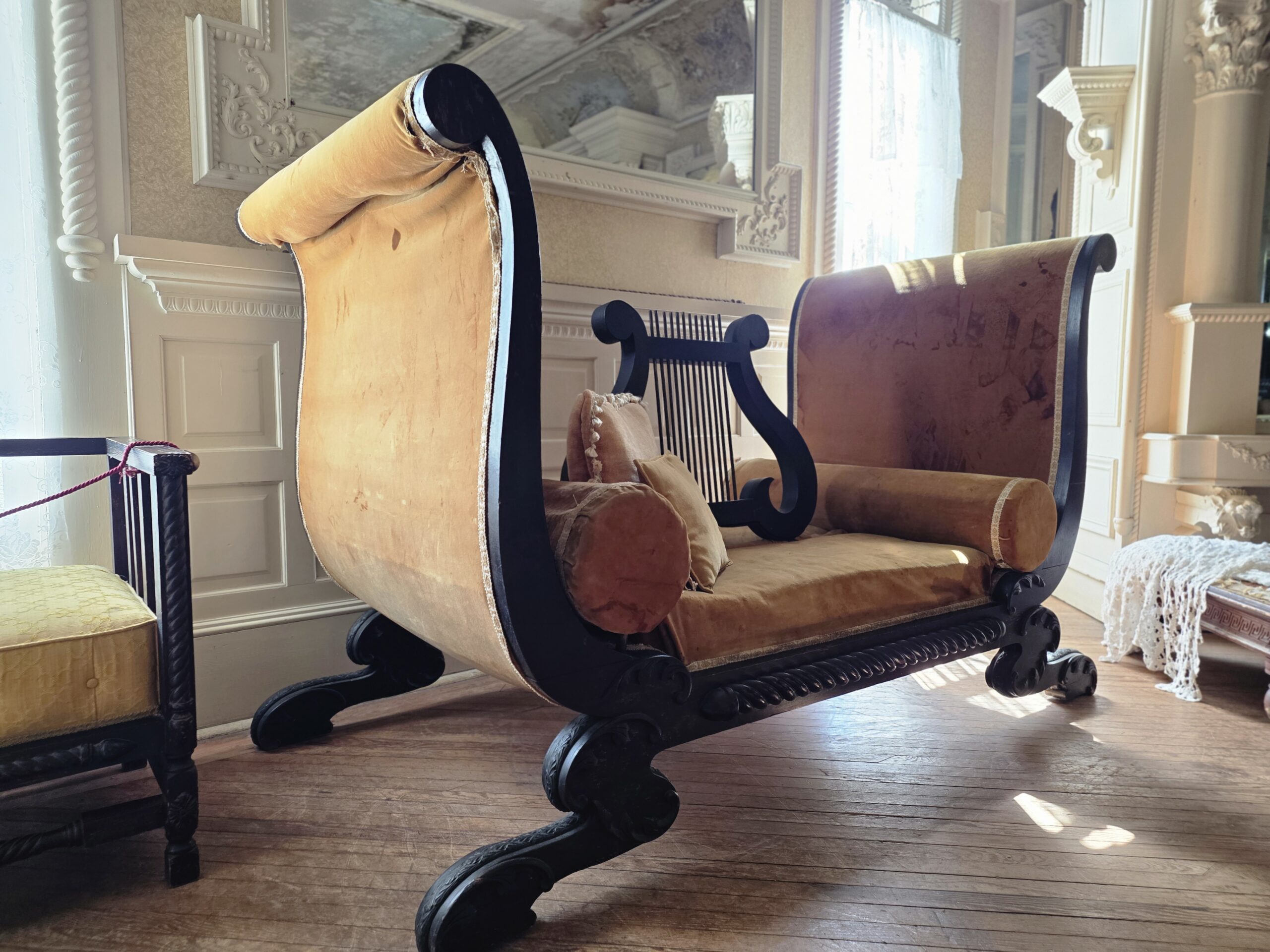
With the beginnings of fall weather comes the enjoyment of cozy interiors, conversation, and fun with family and friends. For this month’s Collections Spotlight, we are highlighting an incredible piece of furniture found inside the Reception Room of Körner’s Folly: the double-sided conversation récamier designed by Jule Körner. Built to complement the space and designed in Jule Körner’s classic style, this unique piece allowed guests of the home to sit on either side while conversing with their friends and family. The beautiful lyre design in the center is also an interesting stylistic choice, creating a division between the two sides without obstructing the view of the room beyond. Both functional and beautiful, the récamier complements the other pieces of conversation furniture designed by Jule and demonstrates his talent for incorporating furniture seamlessly into the design of his interiors.
Conversation chairs, chaise lounges, settees, and récamiers have a long history within European furniture traditions and became particularly popular in the elaborate interiors of the Victorian era. As social customs surrounding entertaining, courtship, and appropriate behavior became an important part of Victorian life, specialized conversation furniture provided comfortable and intimate spaces for guests to visit and socialize. A récamier is a small upholstered seat designed to accommodate a person in a lounged position, with two raised ends, sometimes with no backing to the piece. It is usually the length of a sofa, and can hold more than one person seated. Récamiers could accommodate conversation while still reflecting the social conventions of the period, making them a natural addition to parlors, reception rooms, and other spaces intended for entertaining.
The history of the récamier dates to the turn of the 19th century, when a distinctive style of chaise longue became associated with French socialite Juliette Récamier. In 1800, artist Jacques-Louis David immortalized Madame Récamier reclining upon an elegant, elongated couch in his famous portrait. The furniture form soon became known by her name, with its characteristic raised ends and graceful silhouette appearing in homes throughout Europe and America. By the Victorian era, variations of the design continued to inspire furniture makers, who adapted the form to suit changing tastes and decorative styles.
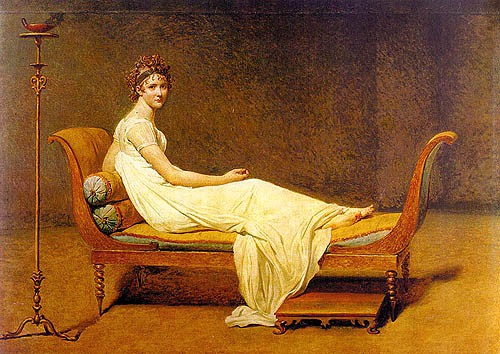
This famous portrait by Jacques-Louis David, housed in the Louvre, depicts French socialite Juliette Récamier reclining upon an elegant chaise longue. The distinctive form of the furniture would later become known as a récamier, named in her honor, as both the sitter and the artist were celebrated figures of their time.
The double-sided récamier designed by Jule Körner was especially well suited to this type of social setting. Guests could sit side-by-side on either side of the piece, while the tall, curved arms created a sense of separation and intimacy without completely enclosing the occupants. In this way, the furniture was both functional and thoughtfully designed for the social environment of the Reception Room.
Perhaps one of the most interesting features of this particular piece is that it has no “dead side.” Many conventional sofas and chairs were designed with a defined front and back, meaning that they were typically positioned against a wall or in another location where the back would not interfere with the room. Jule’s piece, however, was designed to be appreciated and used from either side. There is no side that is simply meant to face a wall. This made it especially well suited to the Reception Room, where the furniture could occupy space within the room while still allowing guests to sit, converse, and interact on either side.
This attention to both function and visual design is characteristic of Jule Körner’s work. He did not simply furnish the rooms of Körner’s Folly; he designed furniture that worked as part of the larger interior. The unique récamier’s elaborate framework, sweeping curves, and decorative details complement the architecture and ornamentation surrounding it, making the furniture itself part of the overall design experience.
Perhaps the most distinctive detail is the harp-like design at the center of the piece, called a lyre. A lyre is a hand-held musical instrument, similar to a harp, used by the ancient Greeks and other early cultures to accompany singing and poetry. Rather than using a solid divider between the two sides, Jule incorporated an openwork design that resembles this instrument, paying homage to classical motifs found throughout the Reception Room. The lyre creates a subtle division between the two seating areas while still allowing light and the decorative elements of the room to remain visible beyond it. Although Jule Körner was not a musician himself, music and the fine arts were important parts of the imaginative world he created within Körner’s Folly.

An image of the Reception Room alcove painted by German artist Caesar Milch, highlights several classical motifs, including a lyre, an aulos (an ancient Greek wind instrument), and a theatrical mask. These elements reflect the musical and dramatic traditions of ancient Greece, reinforcing the room’s artistic and theatrical character.
The murals and statuary within the room further emphasized classical influences, drawing inspiration from mythology and ancient Greek culture. Together, the furnishings and decorative imagery evoke a world of storytelling, artistic expression, and classical ideals. Throughout Körner’s Folly, Jule incorporated theatrical, artistic, architectural, and decorative elements into his designs, often transforming ordinary functional objects into works of art. The lyre motif featured on this piece of furniture is yet another example of his ability to merge utility with artistic expression, making even a practical furnishing an extension of the room’s larger visual narrative.
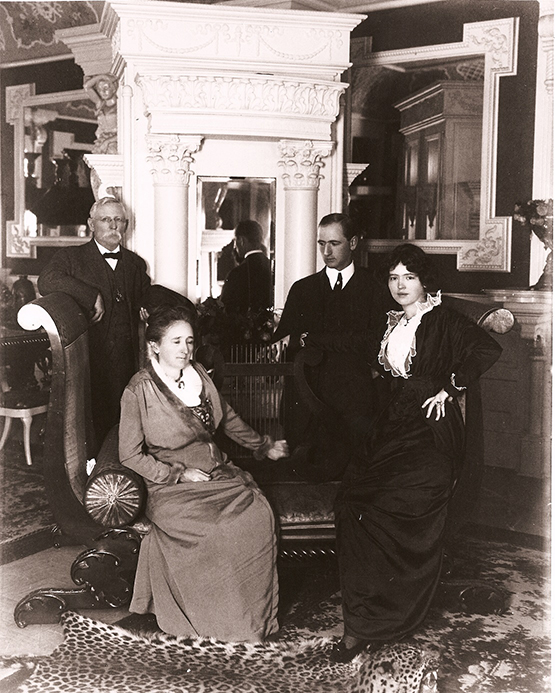
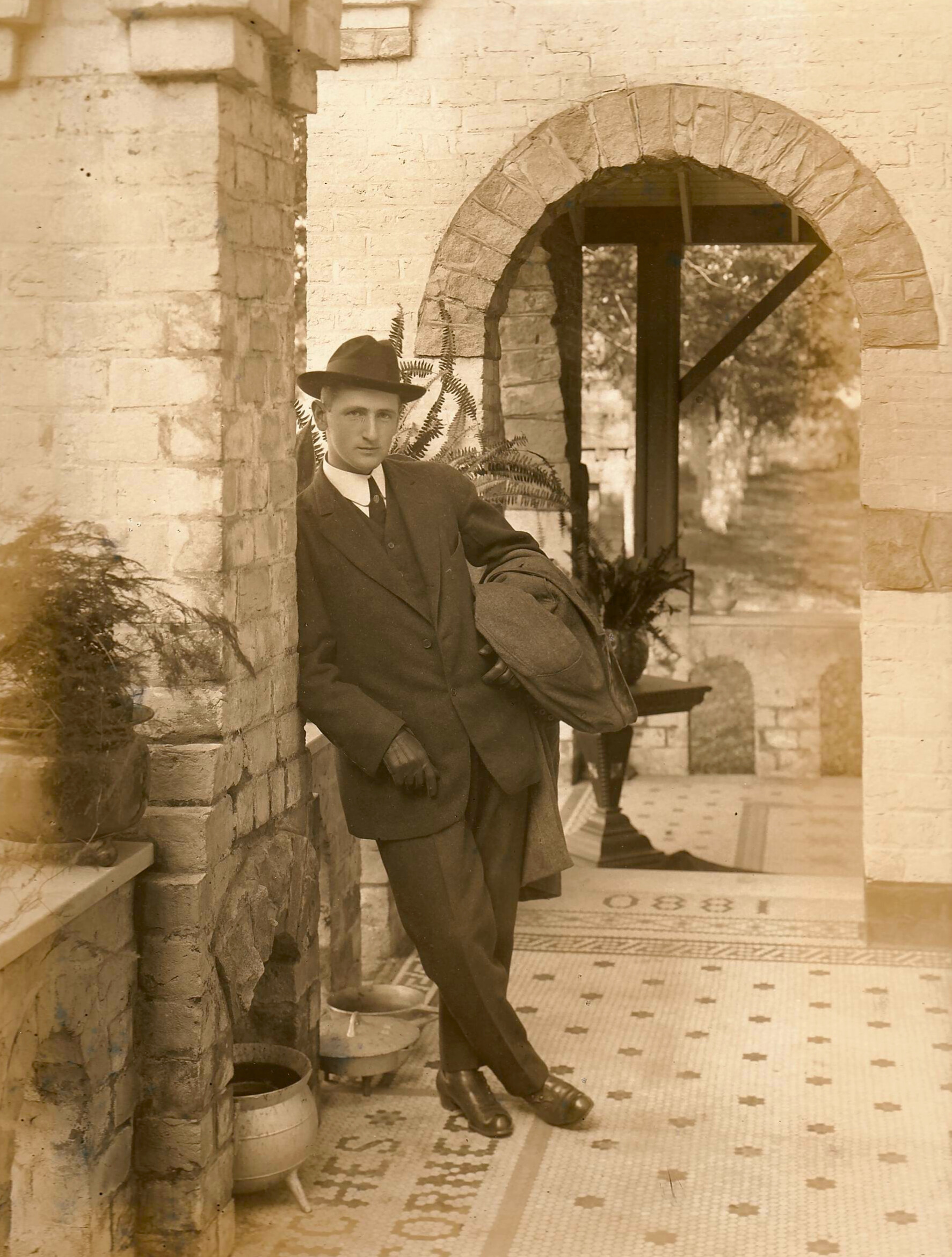
Taken around 1907, this historic photograph gives us a glimpse of the récamier in use more than a century ago, surrounded by members of the Körner family.
While touring Körner’s Folly, it is easy to imagine the Körner family and their illustrious guests gathered in the Reception Room, enjoying conversation, entertainment, and one another’s company beside a warm fire. The next time you visit, take a moment to admire this remarkable piece of furniture and imagine the many conversations it may have witnessed throughout its history.
From the Archives: Jule and Polly Alice Körner’s Silver Wedding Anniversary Party
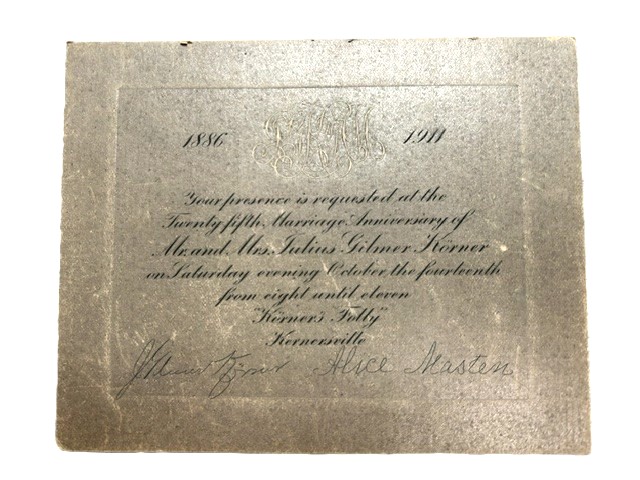
Invitation to the “Silver” Wedding Anniversary for Jule and Polly Alice Körner held at Körner’s Folly in October, 1911.
October brings the wedding anniversary of Jule and Polly Alice Körner, who were married on October 14, 1886. In 1911, the town came together to celebrate their 25th wedding anniversary with a lavish party held in their honor. Known as a “Silver” wedding anniversary, the 25th anniversary was part of the tradition of associating different materials or gifts with each year of marriage.
Local newspapers captured the beautiful decorations and festivities surrounding the occasion. An excerpt from the Twin-City Daily Sentinel, titled “Silver Wedding of Mr. and Mrs. J. Gilmer Körner,” offers a glimpse into the celebration:
“On Saturday night “Korner’s Folly,” the handsome home of Mr. and Mrs. J. Gilmer Korner, in Kernersville, was the scene of a brilliant reception, from eight to eleven, the occasion being the silver wedding anniversary of Mr. and Mrs. Korner.
The guests were greeted at the north and west entrances by Mr. Joseph J. Korner, of Kernersville, and Mr. Henry C. Korner, of Winston-Salem, the senior and junior brothers of the host. Miss Emma Lowery welcomed the guests, while Miss Lucille Stafford received the cards.
Passing into the smoking room, the gentlemen were greeted by Mr. Philip Korner, while the ladies were directed to the cloak rooms upstairs by Mrs. Charles Creech. Presiding here was Miss Nellie Davis.
The spacious reception room in this artistic home is done in tones of brown, and the lavish use of ferns and palms made a rich setting for the happy scene.
The guests, in parties of thirteen, were shown to the Arch Room, where they were received by Mrs. Henry Korner and Mrs. S.L. Spach, of Winston-Salem. The walls of this pretty room are paneled in yellow silk damask, and the decorations here consisted of pink roses and asparagus fern.
The lovely dining room was an enchanting scene wrought out in white and silver. Upon a handsome lace piece in the center of the table, stood a big silver basket overflowing with white roses, the basket’s handle tied with a fluffy bow of white tulle. Radiating from this, were four narrow silver trays filled with ferns, and terminating in candelabra with silver shades. At one end of the table was a large monogram of the “bride and groom,” wrought in silver. Great silver vases of white roses and asparagus fern, the stems tied with white tulle, stood on sideboard and buffet, still further emphasizing the white and silver motif.
From here the company was shown to the music room, where Brockmann & orchestra from Greensboro dispensed sweet music. The decoration here were affected by the use of many palms and ferns, brightened with star daisies.
A great many gifts in handsome silver were sent to Mr and Mrs. Korner, which will long be cherished as mementos of this joyous anniversary.”