Archive for the ‘News’ Category

Interior Restoration Continues!

New Year Brings New Restoration Projects to Körner’s Folly

Historic Körner’s Folly is pleased to announce the continuation of Operation Restoration, a long term project with the goal of restoring and preserving the Victorian house museum. Körner’s Folly will be kicking off 2018 with the restoration of three rooms – the Cellar, Smoking Lounge, and Den. Work began in early January and is expected to take three months. Tours will continue while restoration is being completed.

From 2012-2015, the first major restorative work took place at Historic Körner’s Folly, completely stabilizing the exterior structure of the 1880s Victorian House. The foundation was repaired, the porches were restored, and the entire roof was replaced. Now that the home is water-tight and structurally stable, interior restoration work is underway. This new chapter of interior restoration work focuses on restoring and preserving Jule Körner’s original interior décor for the education and enjoyment of the public. These three rooms are facing the greatest deterioration from decades of water damage, and pose real concerns.

Of the project, Dale Pennington, Körner’s Folly Executive Director says, “The Smoker, Den, and Cellar are three of the most badly deteriorated rooms inside of Körner’s Folly. It takes great forethought by donors to support the rooms in most need of restoration. All of the rooms in the house have been given a ranking based on deterioration, safety concerns, and historical significance. These three rooms hit all three of those markers and are our highest priority for restoration, so it’s especially exciting to see these work begin.” Once complete, these rooms will make push Korner’s Folly several steps closer to being fully restored, leaving 10 remaining rooms in need of donations for restoration.

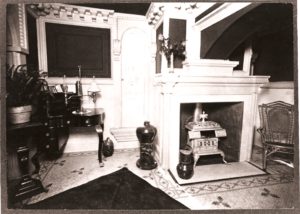
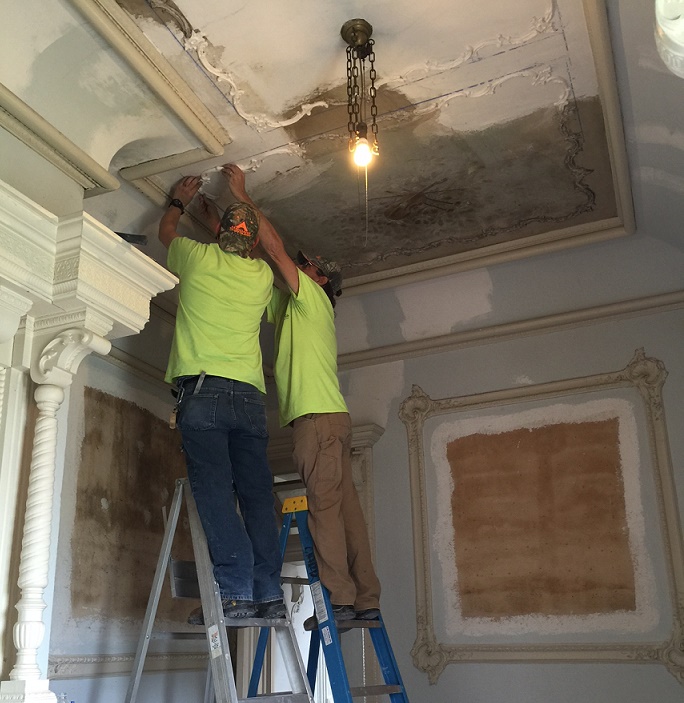
Men’s Smoking Lounge, before restoration

Men’s Smoking Lounge, before restoration

The Smoker, also called the Men’s Smoking Lounge, and the adjacent Cellar will be returned to their 1890s appearance and color scheme. The Sewing Room, which is being renamed “The Den” based on new documentary evidence will be returned to its 1906 appearance. “Since Jule Körner was constantly changing and renovating Körner’s Folly, it is important to us to represent a variety of time periods throughout the house through the restoration process. As an interior designer, Jule was always experimenting with new colors, wall papers, tiles, and finishes, and we want Körner’s Folly to be reflective of that, so visitors can better understand how the house changed over time.” There were two major periods of renovations for Körner’s Folly that are well documented: in the early 1890s, after Jule married his wife and they started having children, they renovated the home to accommodate the growing family, and again from 1903-1908, when Jule reportedly spent $17,000 to renovate the house (over $400,000 in today’s dollars) after his children left home for school.

Restoration is the process of depicting the form, features, and character of a property at a particular period of time. All three rooms sit on the original concrete slab foundation, which caused significant water and moisture issues over the years. The water issues have been remediated, and now the interior plaster and carpentry can be repaired and replicated without further threat of damage. The restoration in these rooms will include removing modern elements added over time, replicating and repairing missing or damaged woodwork and tile, refinishing and cleaning the architectural surfaces, and returning the rooms to their original color schemes.

Sewing Room, to be renamed the Den, before restoration

Sewing Room, to be renamed the Den, before restoration

The home will remain open for tours throughout the restoration. It is a very unique time to see Historic Restoration in action, so be sure to ask staff about the restoration process while on tour. Tour routes may be altered slightly to accommodate the work, and at times, 1-2 rooms may periodically close, call ahead for information on closings (336) 996-7922.

Körner’s Folly is open for self-guided tours Wednesdays-Saturdays 10 a.m. – 4 p.m. and on Sundays 1 – 4 p.m. The last tickets are sold at 3 p.m. to allow visitors adequate time to explore and enjoy the museum. Private guided group tours are available by appointment. 

Interior Restoration continues at Körner’s Folly

Historic Körner’s Folly, 413 South Main Street, is pleased to announce the continuation of Operation Restoration, a long term project with the goal of restoring and preserving the Victorian house museum.

Jule Körner died in 1924, and his wife died in 1934.  After that, Körner’s Folly was never again lived in as a full-time family home.  Over the decades, time, age, and weather have all taken their toll on Körner’s Folly.  Despite multiple re-purposes, by the 1960s, the house sat unused and vulnerable to vandalism.  Fortunately, in the 1970s, a group of 26 local families, including Körner descendants purchased the house.  Their goal was to restore and preserve Körner’s Folly for the education and enjoyment of the public.  They eventually created the Körner’s Folly Foundation, a nonprofit organization, and had the house listed on the National Register of Historic Places.

Over 40 years later – from 2012-2015 – the first major restorative work took place, to completely stabilize the exterior structure of Körner’s Folly.  The house’s foundation was repaired, the porches were restored, and the entire roof was replaced.  Now that the home is water-tight and structurally stable, interior restoration work is underway.  This summer, restoration work began into the home’s main kitchen.

Restoration is the process of depicting the form, features, and character of a property at a particular period of time.  Throughout the restoration process at Körner’s Folly, the Foundation focuses on the house’s 1897-1905 appearance, when the home was at the height of family activity.  The goal is to move through the house, restoring one room at a time, so the house is never closed for tours.  New rooms are being restored each year, three were completed in 2015.  It is a remarkable time to see historic restoration in action.

One of the most challenging aspects of restoring the 135 year-old house is to maintain the home’s historic charm, character, and “lived-in” feel.  Although restoration work brings in new materials and revitalizes each room, it is important that Körner’s Folly remains historic in appearance, and is not overly restored to look brand new.  For example, during the kitchen restoration, extra care was taken to save the original tile floors and hardware, rather than replace them with a modern equivalent.

The first step in the restoration process is to research the history of the room, including the original paint color schemes.  To determine the original paint colors of the kitchen, David Black, AIA/APT of HagerSmith Design of Raleigh, North Carolina, took multiple paint samples of the kitchen. Samples were removed from the wood trim, doors, window sash, wall plaster, and built-in cabinets using a scalpel. Each sample was evaluated with a microscope to identify its original color.

With the historic color analysis complete, work began to repair unstable infrastructure, remove modern elements added to the house over time, replicate and repair missing or damaged plaster details and woodwork, and refinish, clean, and paint architectural surfaces.  However, this project really came to in the final phase – when painters were able to successfully restore the kitchen to Jule’s original color scheme. The plaster walls and the furniture have been returned to a dark red color; the wood window and door trim, window sash, ceiling, baseboards, fireplace trim, and cabinet doors are dark brown – a distinctly Victorian look.  The dark trim and vibrant color scheme will offer visitors a stark contrast to the previously white walls and trim in the kitchen.

As we peel back the layers of paint, read through family letters, and look back at old photographs, we begin to gain a better understanding of not only the house itself, but also the people who lived, breathed, and slept here. Even more of Jule’s eccentric personality becomes clear when we uncover the original color schemes. The floor tiles match the original wall colors, giving visitors a better sense of Jule’s original vision. We learn about the family’s likes, their interests, their joys, and their fears. Eventually, as all the pieces begin to come together, we gain a glimmer of what it might have been like to live here.

Restoration of the Kitchen is made possible by Wolfe & Associates in Honor of Mary Cook for her more than twenty years of service to the Law Firm and her many years as Board Member and Secretary of the Körner’s Folly Foundation.  Stay tuned for more information about this exciting restoration project!

Main Kitchen before restoration. Note the white walls and furniture.


Main Kitchen before restoration. Note the white walls and furniture.

Operation Restoration moves inside

Posted on | News

As summer approaches, the Körner’s Folly team is thrilled to announce that our inaugural interior restoration projects, the Rose and Blue Bedrooms, are nearing completion and may once again be viewed during public tours! The Rose Room’s walls are back to the color Jule painted them for his daughter Dore in 1905, and furniture has been returned to the room. We are still finishing some of the finer details, but visitors may walk into the room during tours to experience all of our restoration team’s hard work. We learned a great deal about the process of historic restoration during work on the Rose Room and were able to build relationships with several skilled craftsmen in the area to help us achieve our ultimate goal of restoring the entire Folly to its original luster.

The Blue Room–Jule’s son Gilmer’s bedroom–is next on our list of interior restorations to be completed this year; we hope to have it finished in late June. Painting was recently completed, allowing us to reopen the room for public viewing. Extensive work is continuing on the room’s textiles, specifically the wall panels and drapery. Once these final, details are complete, we will return furniture to the Blue Room and visitors will be able to see the completed room as it looked to Gilmer in the early 1900s.

Observing historic restoration work first-hand is a unique opportunity, one we are excited to share with our visitors. Historic restoration is frequently hidden behind a curtain or closed door, but at Körner’s Folly, we strive to share as many unique experiences as possible with the public and embrace the Folly’s past along with our dreams for its future. We hope you will join us during the coming months to experience Operation Restoration and view Körner’s Folly during this exciting process.

In a recent article published in Volume 37, Number 2 of The Public Historian, Körner’s Folly received accolades for encouraging visitors to experience this lengthy process firsthand. The article’s author, Franklin Vagnone, noted that “the in-between states of preservation and natural decay allow for a very rare quality of preservation voyeurism” (Vagnone, Ryan, & Cothren, 2015). For a PDF of Vagnone’s entire article in The Public Historian, click here.

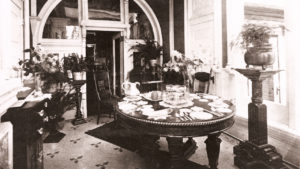
Rose Room, circa 1905

Rose Room, circa 1905


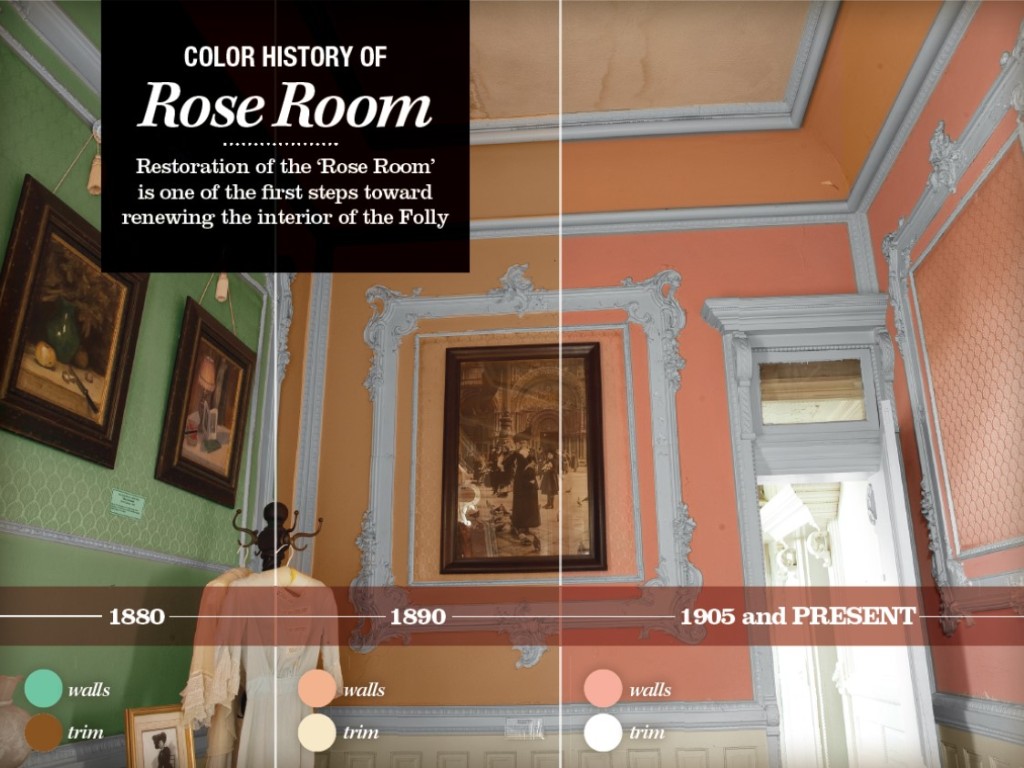
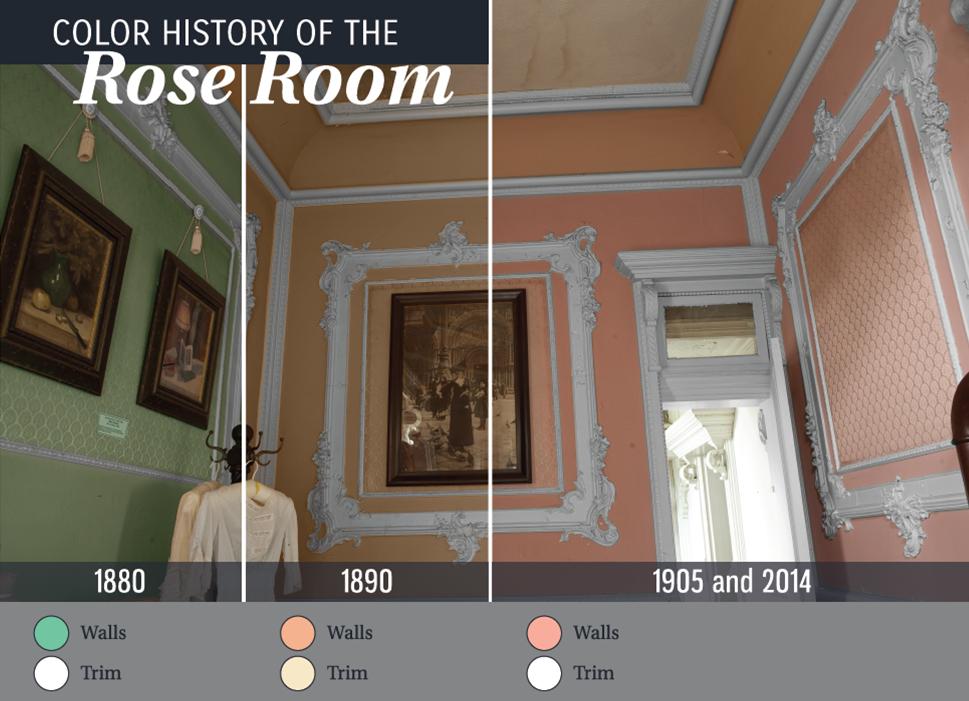
Rose Room Color History

Rose Room Color History

Blue Room, plaster details being replicated, March 2015

Blue Room, plaster details being replicated, March 2015

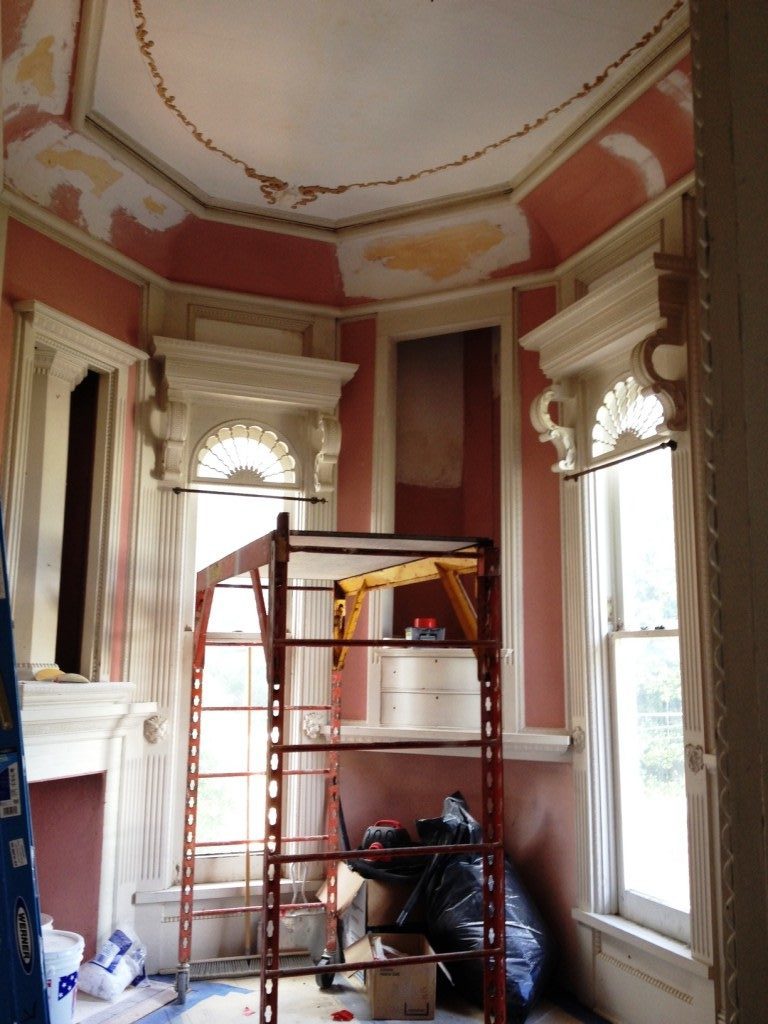
Rose Room, Under Construction, February 2015

Rose Room, Under Construction, February 2015


Inaugural interior restoration: The Rose Room

Historic Körner’s Folly has undergone major exterior restorative work over the last 2 years.  And now, the work is moving inside.  The Rose Room, Jule Körner’s daughter Doré’s bedroom, is the first to undergo serious interior restoration work.  The Körner’s Folly Foundation hopes to bring the room back to its 1905 condition, when Jule renovated the room for Doré’s sixteenth birthday.

The restoration process will involve a variety of components.  In order to understand the color and material of the walls when Doré used the room, a paint analysis has been done of the current plaster.  This step will allow us to know the exact colors of the room when it was occupied by Doré, giving us an appropriate color palette for other objects and patterns in the room.

Like the rest of the building, the Rose Room contains many original decorative features.  Plaster moldings will be recast and wood details will be duplicated to mimic Jule’s original design.  The pine floors, painted grey over the years, will be sanded down to their original wood finish. The Körner’s Folly Foundation Director, Dale Pennington, feels the efforts will provide new insight into Jule Körner’s dynamic personality as well as provide a better understanding of local life in Victorian America.  She remarks, “The restoration process feels a bit like being a history detective.  As we start to peel back the layers of paint, read through family letters, and look back at old photographs, we begin to gain a better understanding of not only the room itself, but also the people who lived, breathed, and slept there.”

Fortunately for the Körner’s Folly Foundation, the Rose Room is an excellent room to learn from.  Relatively well preserved, our work during this restoration stage will provide us with the insight and knowledge to move forward with larger and substantially more deteriorated rooms.  The Foundation hopes the challenge of restoring the Rose Room will also build connections in the community, helping us develop a network of conservators in the area.

The restoration process is not only a venture for the Körner’s Folly Foundation, but is very close to the hearts of the remaining Körner descendents.  With many Körner relatives active in Kernersville, they are excited to see their mother, grandmother, great-grandmother, and even great-great-grandmother’s room restored for the public.  The restoration project, funded by Wolfe & Associates, is in honor of Doré Körner’s daughter, Polly Körner Donnell Wolfe.

The Körner’s Folly Foundation is accomplishing these goals within the framework of its mission, to preserve and restore Körner’s Folly for the education and enjoyment of the public.  A beloved landmark within the Kernersville community, the Folly has become a destination for many families within North Carolina, as well as throughout the nation and abroad.  The Folly’s ability to educate the public about life in Victorian America and Jule’s incredible design vision have compelled many to support our efforts to restore Jule’s home and business.

Körner’s Folly is the architectural wonder and home of artist and designer Jule Gilmer Körner.  Built in 1880 in Kernersville, North Carolina, the house originally served to display his interior design portfolio.  The house is comprised of twenty-two rooms, separated into three floors on seven levels, with ceilings ranging in height from five and a half feet to over twenty-five feet tall.  In every room, Jule designed unique doorways, windows, and fireplaces, hoping to attract clients who visited his home.

Color History of the Rose Room, Korner's Folly

Color History of the Rose Room, Korner’s Folly

Roof Restoration Begins: See historic preservation in action!

While construction is taking place, Körner’s Folly will remain open for tours during regular hours (Thursdays – Sundays). Visit us this summer to learn more about our future restoration plans and current roof restoration projects.

The Körner’s Folly Foundation has begun the final phase of exterior restoration, which involves replacing Körner’s Folly’s red tin roof with shingles. This milestone marks the largest restoration project in the history of Körner’s Folly. The red tin was installed in the mid-1950s to replace the home’s original chestnut shingle roof, and now the Foundation has raised enough money through Operation Restoration to replace the tin with eco-friendly and historically appropriate synthetic chestnut shingles.

The Foundation launched Operation Restoration in 2012 as a campaign to fund exterior restoration, which is the first step in bringing back the house’s original Victorian splendor. Water damage from a leaking roof and cracks from a shifting foundation have prevented any large-scale restoration projects. With a new roof and stable foundation, moving forward really means moving Körner’s Folly backward to its 1880s magnificence.

Bringing Körner’s Folly back, however, is expensive and fundraising was an enormous undertaking. The financial goal for Operation Restoration was $500,000, and generous community supporters exceeded this through their contributions.

“The restoration project wouldn’t be possible without support from the community,” Executive Director Dale Pennington said. “The Foundation’s mission is to keep Körner’s Folly open for the education and enjoyment of the public, and restoration is essential in making this possible.”

Looking forward, the Foundation plans to begin interior restoration in late summer. With a new water-tight roof, the Foundation will begin restoring the 22 rooms inside Körner’s Folly. The Rose Room is already empty with drop cloths on the floor, awaiting completion of roof restoration this summer.

While construction is taking place, Körner’s Folly will remain open for tours during regular hours. Visit us this summer to learn more about our future restoration plans and current roof restoration projects.

Challenging Renovation… March 2013

KERNERSVILLE, NC—Historic Körner’s Folly, 413 S. Main Street, is facing a remarkable challenge.  A $150,000 challenge to be exact, and the structural stability of the house is riding on it.  As it turns out, the Körner’s Folly Foundation is actually welcoming this particular challenge—in fact, the Foundation is downright thrilled.

In August of 2012, an anonymous donor and descendents of the Körner family issued a challenge to the Körner’s Folly Foundation.  They offered to donate $150,000 specifically for the structural restoration of Körner’s Folly, IF, and that’s a big IF, the Körner’s Folly Foundation can raise $150,000.  And there’s more: they must raise the matching funds by December 2013.  If the Körner’s Folly Foundation is successful, they will then have $300,000 to structurally repair Körner’s Folly.  The structural repairs include stabilizing the foundation of the house and restoring the Folly’s iconic roof.  Upon completion, these repairs would structurally stabilize Körner’s Folly for at least the next 100 years.  The matching challenge is certainly a tall order, no doubt about that, but the Körner’s Folly Foundation is hopeful of community support.

The challenge and structural repairs are part of the Körner’s Folly Foundation’s long term restoration plan, “Operation Restoration,” which outlines a mission to restore the exterior and interior of the house.  Exterior restoration has been divided into three major phases:

Phase 1:  Front and Side Porch Restoration (Approximately $160,000) COMPLETED

Phase 2:  Foundation Stabilization (Approximately $100,000) COMPLETED

Phase 3:  Roof Renovation (Approximately $200,000) NEEDS YOUR HELP!

The Körner’s Folly Foundation has consulted with many specialists over the years to develop this long-term restoration plan.  They have patched the roof numerous times and did minor repairs to stay ahead of water damage for decades, and it’s been a costly, uphill battle. But now, Operation Restoration is finally being put into action to proactively preserve the house.

This summer, Phase I of Operation Restoration was launched when the Foundation completely restored the intricate brick masonry of the front and side porches thanks to funding from the Lawrence E. Pope Foundation and the Town of Kernersville.   The challenge has created an outpouring of support, which allowed the Körner’s Folly Foundation to begin Phase II, the structural repairs to the foundation, this January.  The house is reopening for public tours as of March 1, 2013.

And now, if the Körner’s Folly Foundation can complete the $150,000 challenge, Phase III, restoring the roof, will complete the structural stabilization of the house.   Thanks to overwhelming community support, in just six short months, Körner’s Folly is almost half way to their goal; having raised $70,000 to date.  The individuals from all over the community have come together to show support for the beloved, albeit strange, town landmark.

The restoration of the roof is a particularly important goal of Operation Restoration because the leaking roof has prevented any interior restoration for decades.  The red tin roof that currently tops Körner’s Folly was installed in 1954 to replace the original chestnut-shingled roof that had weathered considerable damage.  Now, nearly 60 years later, the tin has weathered considerable damage and poses a unique threat to the eight murals on the top level of Körner’s Folly.  The tin roof heats and cools creating considerable temperature fluctuation and condensation that leaches through the plaster walls, to stain the murals that are located just 10 inches on the other side.  Normally, an insulation layer would combat this problem, but no insulation was installed when the tin roof was put on Körner’s Folly.  The goal of the Körner’s Folly Foundation would be to install a more breathable and insulated roof and explore building materials that are more similar to Körner’s Folly’s original roof.  Restoring the 133 year old house has been no easy task, but the Körner’s Folly Foundation is thrilled at the progress so far, and is hopeful progress will continue.

Looking to the future, now that Phases I & II are complete, once the roof restoration is completed, the next major phase would be to start interior restoration.  Interior plans would include restoring the damaged and faded murals, woodwork, and interior plaster, with the ultimate goal of returning it to a sparkling representation of life in Kernersville in the late 19th and early 20th centuries.  Armed with a clearly prioritized master plan to proactively restore Körner’s Folly, the board of directors and executive director now have a clearly focused way of seeking funding.  This systematic approach to restoration has proven successful thus far, and shows a strong commitment to the mission to restore and preserve Körner’s Folly for the education and enjoyment of the public.

Interested in helping Körner’s Folly raise the challenge of $150,000?  Every dollar counts; call (336) 996-7922 for more information or to donate today!

This article appeared in the March 2013 edition of Kernersville Magazine, click here to see the full article: Challenging Renovations…March 2013