


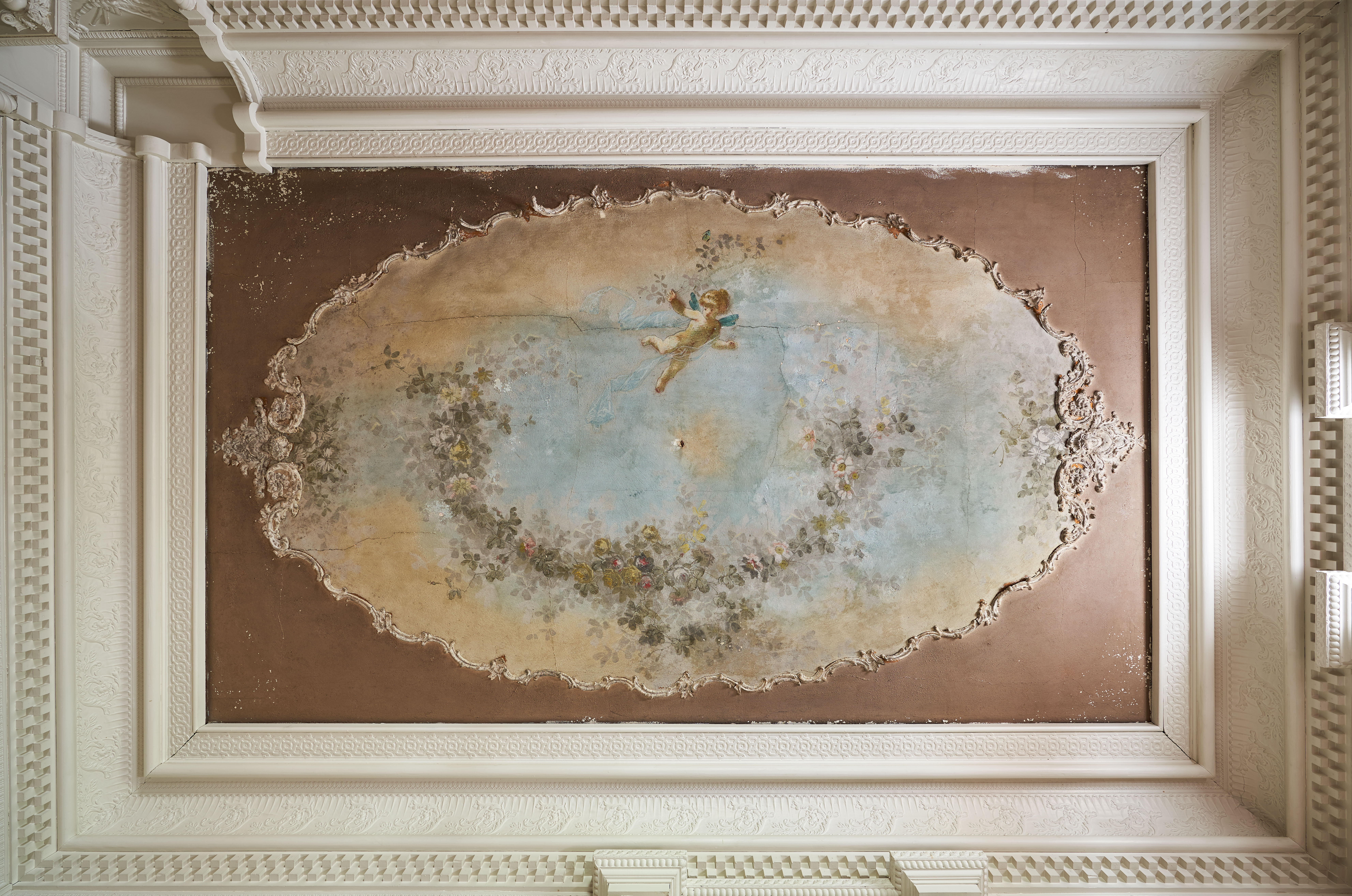
For our June Collection Spotlight, we invite you to explore the remarkable free-hand fresco paintings that grace the interior of Körner’s Folly, each one lovingly created by German artist Caesar Milch. Milch came to work with Jule Körner sometime after Körner’s marriage to Polly Alice Masten in 1886, and he remained a trusted collaborator for the rest of his life. A graduate of the Royal School of the Arts in Berlin in 1894 and an accomplished decorative painter specializing in figures and floral forms, Milch played a vital role in shaping the Folly’s richly ornamented interiors. Under Körner’s visionary direction, Milch helped transform Körner’s Folly into a vivid expression of Gilded Age design at its height, where painting and architecture came together to form a unique immersive artistic environment.
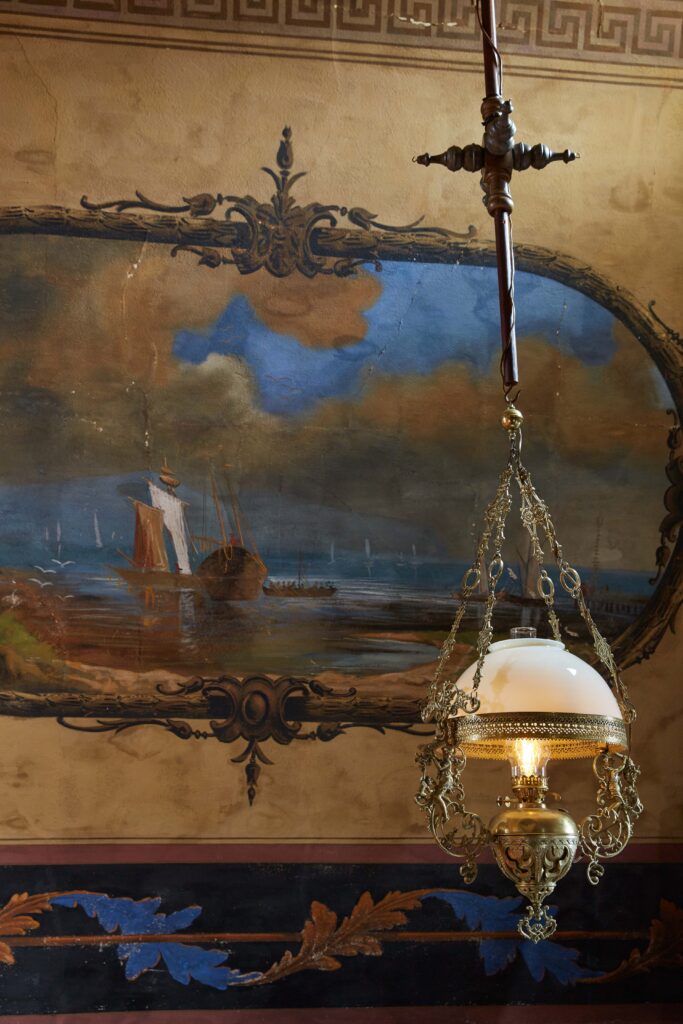
This hand-painted fresco by German artist Caesar Milch reflects the late 1880s fascination with immersive interior design, where walls became storytelling surfaces rather than mere walls. Drawing on European traditions of decorative painting, artists used techniques such as trompe-l’œil and layered washes to create depth, atmosphere, framing, and illusion within their designs, transforming domestic spaces into imagined landscapes. Originally created from a maritime scene of Holland Jule Körner sketched during one of his travels, scenographic displays offered both escapism and sophistication, aligning the home with ideals of travel, culture, and refinement. In spaces like Körner’s Folly, frescos such as these elevate the interior into a total work of art, where architecture, decoration, and narrative seamlessly intertwine.
During the late 1800s, American design embraced what is often called the “cult of ornament.” Pattern, color, and craftsmanship were highly valued, and interiors became increasingly elaborate. Freehand wall and ceiling painting fit perfectly into this aesthetic. Popular imagery included floral and botanical motifs, trompe-l’œil and architectural details, classical scenes and allegorical imagery, and intricate borders and ceiling medallions. These designs were especially popular in theaters, music rooms, and grand homes, especially in spaces meant to impress and entertain.
Specifically, freehand fresco-style decoration became fashionable in American interiors during the late 19th century as part of a broader shift toward highly personalized, artistic living spaces. As a reaction to mass production and the Industrial Revolution, affluent homeowners and designers began embracing hand-painted walls and ceilings that reflected European traditions, individual taste, and a growing appreciation for fine art within the home.
The roots of this trend lie in European fresco traditions, particularly those of the Italian Renaissance and later decorative arts movements in France and Germany in particular. As artists trained abroad, such as Caesar Milch’s time at the Royal School of the Arts in Berlin, ideas were brought from Europe, carrying these techniques with them. Fresco and fresco-secco allowed for richly detailed, custom designs that elevated interiors beyond simple decoration into immersive artistic environments.
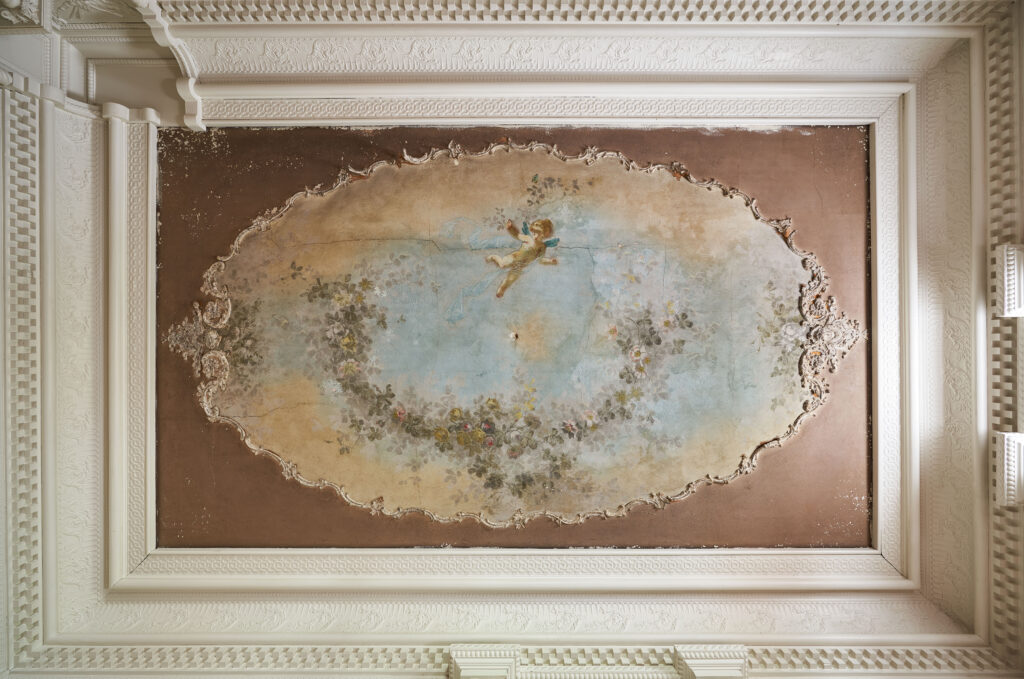
Framed by an ornate plaster cartouche, the composition centers on a delicately rendered putto drifting through an illusionary sky, encircled by a garland of florals. Another example of a fresco by German artist Caesar Milch, he employs techniques associated with fresco-secco painting, painting on dry plaster, utilizing subtle tonal gradation, diffused edges, and a muted pastel palette. This design style was to evoke an illusionistic depth that dissolves the architectural boundary of the ceiling, a popular trend in highly ornate homes from the 1800s. Such compositions draw from Rococo and Neoclassical precedents popularized in 18th century France and Italy, and later revived in Germany during the 19th century. Imagery such as this putto were utilized as symbols of refinement and cultural sophistication in domestic spaces. In Victorian America, particularly in homes like Körner’s Folly, these hand-painted ceilings demonstrated both the skill of the artist and taste of the designer while transporting the viewer into a scenic view of the illusionary heavens.
Milch drew upon the popularity of ornamental painting during his work at Körner’s Folly, as well as in other projects completed through the Reuben Rink Company. His training took place at a time when decorative fresco and interior embellishment were at the height of fashion, shaping both his technique and artistic direction. Milch studied fresco painting and design under the guidance of Phillip Franck, a noted instructor of plaster drawing and ornamentation who began teaching in 1892 and later served as acting Director of the art school from 1912 to 1929. An accomplished author and influential figure in the reform of drawing and art education in Germany and Prussia, Franck left a lasting international impression on the study of ornamentation and design.
Milch’s work with the Reuben Rink Company reflects his academic foundation, with clear ties to those principles with his stylistic approach in creating highly ornamental designs. By the early 20th century, tastes began to shift in interior design due to changing philosophies with interior spaces, leading to a decline in elaborate painted decoration. However, surviving examples, like those of Körner’s Folly, offer valuable insight into a moment when interiors were conceived as immersive, handcrafted environments. These works remain important not only as decoration, but as expressions of artistic collaboration, cultural exchange across oceans, and the aspirations of America’s Gilded Age.
From the Archives:
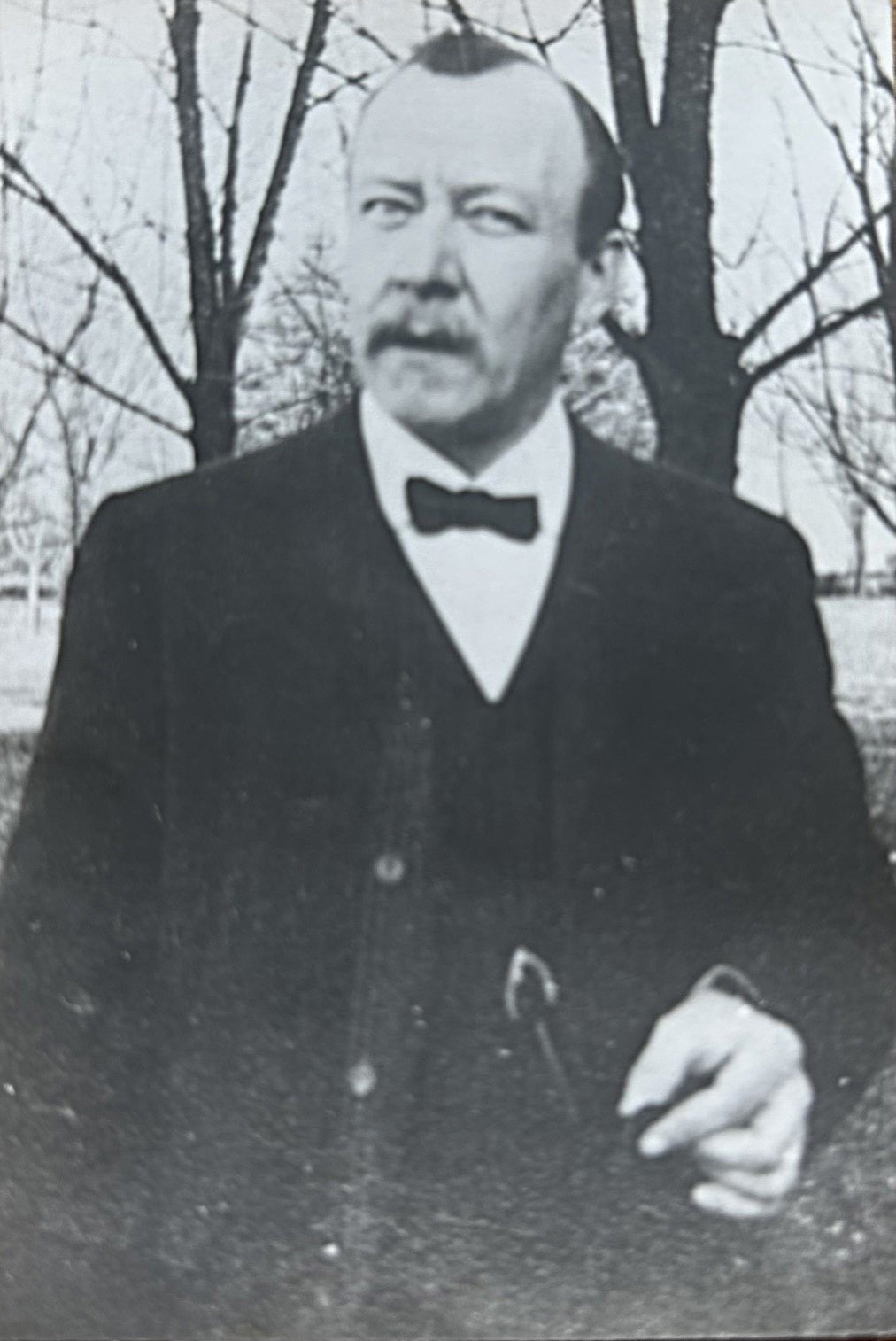
This photograph depicts Herr Caesar Milch in the late 1910s, a close personal friend of Jule Gilmer Körner and the freehand fresco artist for the Reuben Rink Decorating and House Furnishing Company. Milch collaborated alongside Körner for more than 30 years, remaining in his employ until his death in 1922. With the exception of the wall mural in the North Stairway, painted by Körner shortly after 1880, the surviving murals throughout Körner’s Folly are attributed to Milch’s skilled hand.
Milch joined Körner not long after Jule’s 1886 marriage to Polly Alice Masten of Winston-Salem. In her memoir I Remember, Polly Alice recalls, “Later, I cannot recall how soon after we were married but not long thereafter, Jule went to New York and brought back a young German artist (Caesar Milch) from Berlin, who set to work to decorate all the walls and ceilings up there (Cupid’s Park Theatre). He was at that job for many months and that was the beginning of a lifelong employment of Herr Milch, who was never out of Jule’s employment as long as they both lived.”
Though dedicated to his work in Kernersville, Milch periodically returned to New York and Germany to refine his craft. In 1893, he traveled to Berlin to visit family and further his artistic training at the Royal School of the Arts, a state institution established in 1869. By the turn of the 20th century, the Reuben Rink Company proudly promoted Milch as a graduate of this prestigious school, declaring he “has no peer in this country in the artistic field.”
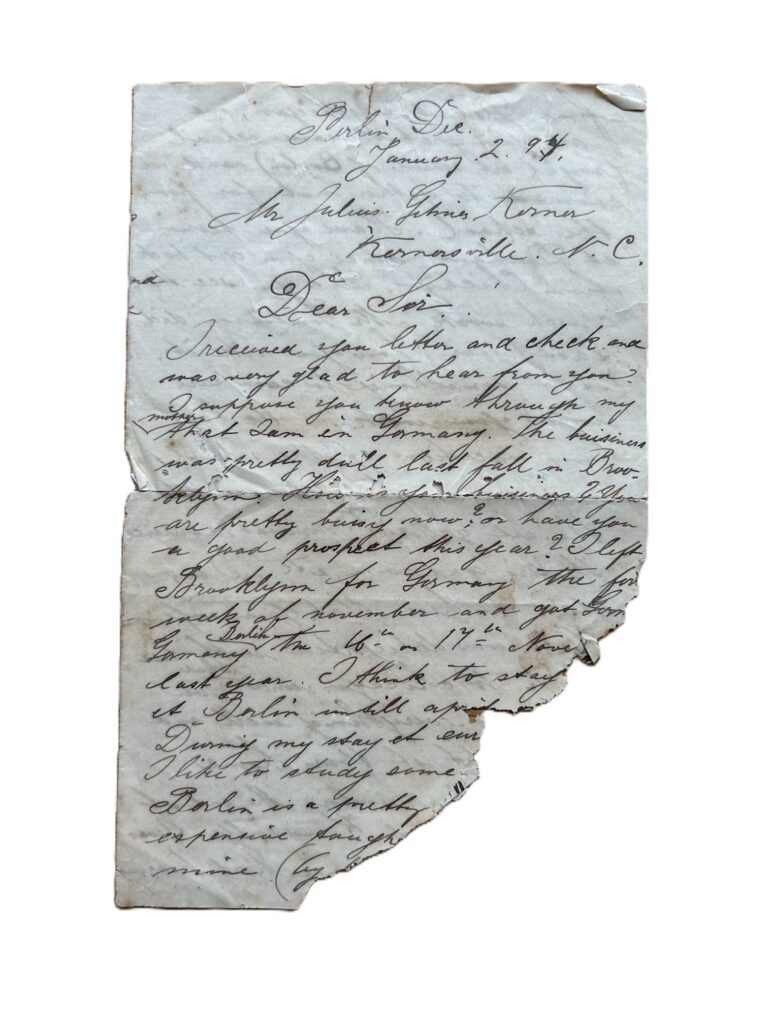
The letter displayed here, written by Milch to Jule Körner during his time in Berlin in 1894, offers a personal glimpse into his artistic pursuits abroad and reflects his enduring connection to the Körner family and the Kernersville community. Unfortunately, some of the letter is missing, but most of it is preserved. Caesar wrote:
“Berlin, Germany
January 2, 1894
Mr. Jule Gilmer Kerner
Kernersville, N.C.
Dear Sir,
I received your letter and check and was very glad to hear from you. I suppose you know through my mother that I am in Germany. The business was pretty dull last fall in Brooklyn. How is your business? You are pretty busy now? Or have you good prospects this year? I left Brooklyn for Germany the first week of November and got home to Berlin Germany the 16th or 17th November last year. I think to stay here in Berlin until April or May. During my stay at Europe___.I like to study some ____. Berlin is a pretty ____ expensive [though].
From Dihart [sic], Michigan, we are going to the same school [Royal Art School of Berlin] and we room together not far from the school. Have you been at Durham since you got back from Chicago? Did you see the church work Mr. Tomlinson did last year? How you like it? Is it something to compare with your work? We have no vacation at the school and are on foot to see all the fine art gallerys [sic], private residence, theaters, and so on, etc. I was glad to hear that your wife ___ was delighted with her trip to Chicago and that you ____ everything well….
Hard hearing, at home [Brooklyn] and this place also, and now it has been restored, because I went to the dispensary of this place, my hearing seems to be now as well as it has been. I like to make me some inquiries about yours and your wife health? How are your brothers and their wifes [sic]? My grandfather died last year December 22, ‘93 and the funeral was a very fine one. We have it very cold now and plenty of snow. How is the weather at your home?
Please tell your brother Henry and his wife my best regards and I send to all I know at Kernersville my best wishes to New Year. I like to hear a few lines too. I am____
Please let me hear from you again. Please send me a Kernersville News to my address. I like to hear from the old home stead. Kindly regards to you and your beautiful and lovely wife Alice.
I remain,
Respectfully, Yours truly,
Caesar Milch
Care of Royal Art School
Kloster Ln. 57
Berlin
Germany
P.S. Please send your letters and newspaper to my mother’s address and in turn she will forward them.”