


Collections Spotlight:
European Wooden Shoes
In honor of Körner’s Folly’s upcoming 16th Annual Oktoberfest, we highlight a Körner family collection item newly on loan from the Wolfe family. This month we showcase a pair of wooden shoes, most likely of German origin, crafted in the 1800s. At first glance, this pair of simple, wooden shoes may seem like an ordinary object to find among the vast collection of elegant furnishings and decorative objects within Körner’s Folly. Yet these humble shoes may offer a fascinating glimpse into the German heritage of the Körner family and the traditions they carried with them across the Atlantic.

Carved from a solid block of wood, most likely beech or poplar, and shaped to enclose the entire foot, wooden shoes such as these were once common throughout northern and central Europe. In German-speaking regions, wooden footwear was known by a variety of names, including Holzschuhe and Holschen. Practical, durable, and inexpensive, wooden shoes were particularly useful for agricultural and outdoor work, protecting the feet from mud, moisture, and rough terrain. Regional styles varied considerably, and the long, pointed toes of this pair are found in many German speaking regions.
The exact origin of the Körner family’s shoes, whether inherited or purchased, is still being determined, but is consistent with European wooden footwear of the 18th and 19th centuries. By the beginning of the twentieth century, wooden shoes were becoming less common as everyday footwear since inexpensive manufactured leather shoes became increasingly available. Whether the Körner family shoes were once used practically, or were purchased as a token of the family heritage, they showcase a strong cultural connection to the family’s lineage.
Perhaps most intriguing is that the shoes appear in an early photograph of Körner’s Folly dating to approximately 1907. In the photograph, the pair of elongated wooden shoes can be seen resting on the floor of the Reception Room, among the room’s elaborate furniture, rugs, artwork, and decorative objects, just under the ornate “Japanese Cabinet” purchased from the Chicago’s World’s Fair. Their placement in this formal space suggests that they may have held significance beyond their practical use and were an interesting focal point in a room with so much character.
Today, these shoes provide more than an example of historic footwear. They showcase a physical connection between Körner’s Folly and the European heritage of the family who built it. Perhaps these shoes were worn by a Körner ancestor, carried across the Atlantic, or simply a treasured reminder of Germany. We may never know their entire journey. But their appearance in the house more than a century ago tells us one thing for certain, the wooden shoes were important enough to keep and display among all of Jule Körner’s important possessions!

From the Archives:
Gilmer and Doré Trace their Lineage, Post-World War I
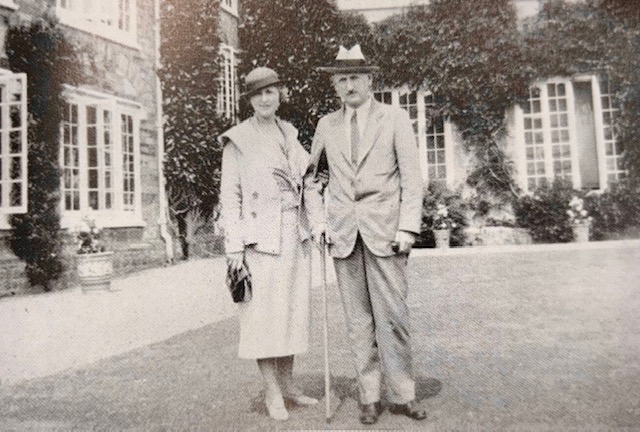
At left: Gilmer Körner and Doré Körner Donnell in 1935. Together, they visited several countries in Europe in search of their family history. In this photo, Gilmer and Doré are in Devonshire, tracing their mother’s lineage.
In 1912, Doré Körner embarked on a Grand Tour across Europe, the Middle East, and Northern Africa, combining a passion for travel with a deeply personal search for her family’s ancestral roots. Among her most important destinations was Germany, where she sought to reconnect with relatives of the Kerner and Körner family lines.
In the Black Forest region, Doré traced her maternal ancestry to the Wintermantel family and established a meaningful connection with her German relatives. What began as an ancestral search quickly developed into a lasting family relationship. Even after Doré returned to North Carolina, the Körner family continued to correspond with their German relatives, exchanging letters and expressing hopes of one day visiting one another again.
The outbreak of World War I, however, made communication increasingly difficult. Despite the conflict separating them, the letters exchanged between the families reveal that the war did not diminish Doré’s affection for their German relatives. One cousin wrote to Doré during the early years of the war, stating:
“We hope this terrible war will soon be ended and that we can correspond again without difficulty. I am very busy, as all others are, for the Red Cross. In eight days, 100 pairs of socks must be finished and sent to the soldiers. Oh, it is all so horrible. I wish you all a very happy Christmas and a joyful New Year, hoping that my next letter may be written in peace. I hope to receive an answer by the New Year. Address me at my cousin’s in Switzerland.”
Though their countries were divided by a devastating international conflict, the family’s personal bond remained. Their correspondence was interrupted by war, but their connection endured. After the war, Doré and her brother, Gilmer, returned to Europe on several occasions to visit their relatives in Germany and continue tracing their family history. Their journeys demonstrate that the war had not turned them away from their German heritage or the family they had discovered there. Instead, they continued to embrace those connections as an important part of their shared ancestry.
After World War I, Gilmer stated he traveled each year to Germany, up until the beginnings of World War II. Today, the German connection remains strong in Kernersville, partially due to the continued connection of the Körner family to their ancestral homeplace and kin.