

The Körner’s Folly Foundation has received a $5,000 grant through the National Trust Preservation Fund from the National Trust for Historic Preservation to support the documentation, assessment, and conservation planning of the historic house’s murals.
This matching award was made possible by a generous gift from Phil & Marcia Byerly, whose support helped launch this important preservation initiative. Their generosity, together with the National Trust’s investment, is helping us better understand these remarkable painted surfaces and plan thoughtfully for their future.
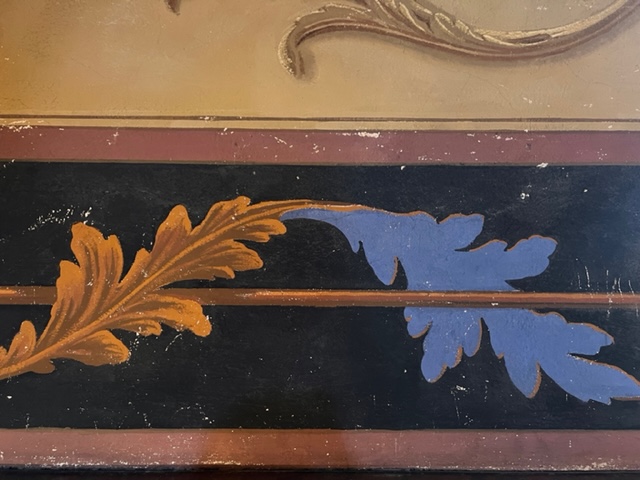
The murals throughout Körner’s Folly are integral to the house’s artistic identity. With the exception of the North Stairway mural, painted by Jule Körner shortly after 1880, the surviving murals are attributed to German artist Caesar Milch, who collaborated with Körner for more than 30 years. These works transformed walls and ceilings into expressions of imagination, demonstrating the close relationship between art, architecture, and interior design that makes the Folly so distinctive.
To guide their care, the Foundation is working with conservator Andy Compton of Compton Studios and Amelia B. Jensen, conservator and paint analyst with Artriage LLC. The project brings together condition documentation, detailed photography, and scientific paint analysis to inform a site-wide mural conservation plan.
Work is already underway. On October 13, Andy Compton and Mary Alrich collected 14 paint samples from ceiling and cove murals in the Reception Room, Long Room, Foyer, and Dining Room. Amelia will examine these samples using cross-section microscopy, studying the layers of paint to help identify original finishes, later overpainting, and relationships among the murals in different rooms. Analysis will also investigate the materials that bind the paints together, providing information essential to choosing appropriate conservation methods.
The findings will be documented in a written report with magnified images and other supporting records. This assessment and planning phase will guide recommendations for future conservation, helping us make informed decisions about how to protect the murals and approach later treatments.
Preservation begins with understanding what we have, how it was made, and what it needs. We are deeply grateful to Phil & Marcia Byerly and the National Trust for Historic Preservation for making this work possible. We look forward to sharing discoveries as the project progresses—and helping visitors see these familiar rooms with new appreciation.
The National Trust Preservation Fund supports preservation efforts by nonprofit organizations and public agencies across the country. Learn more about the National Trust’s preservation grants.
